

Product images are for informational purposes only and may vary slightly depending on the batch and supplier. Product specifications and prices may be subject to change without notice. We do our best to provide accurate and complete product specifications, but they may not be completely accurate. If you encounter any such situation, please let us know.
The product is intended for specialists and requires qualified and authorized personnel. The product does not include assembly/use instructions . Putting the product into operation by unqualified persons leads to the loss of the warranty according to the Terms and Conditions on the site.
The specified technical parameters (current, power, etc.) represent maximum allowable values under ideal operating conditions. For safe use and optimal lifespan, it is recommended to operate the product continuously at no more than 50% of the specified maximum values.
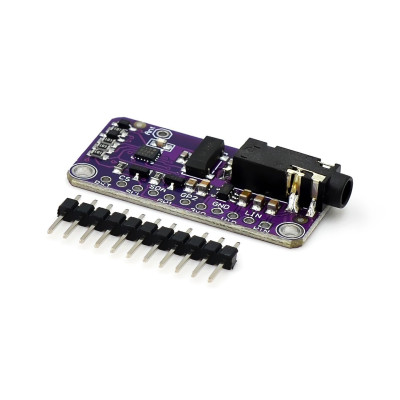
FM transmitter module, SI4713, I2C, 3-5VDC
FM transmitter module with Si4713 for Arduino projects and other boards, controlled via I2C, allows stereo audio output via AUX input and sending RDS information such as song title or messages. It operates at 3-5VDC for easy integration, offers software setting of the frequency and transmission power, with a typical range of up to 10 m which can be increased with the antenna.
Shipping by Thursday 22 October
Buying this product earns you 2.80 RON in loyalty points.

International fast shipping within EU. Free Shipping for orders above 100 EUR in most EU countries.

We ship from our stock within 24H

You earn points with every order, worth 5%.
FM radio transmitter module based on Si4713, with I2C interface, compatible with Arduino, ESP32, and other development boards.
This board can transmit audio and RDS (Radio Data System), a protocol that allows the integration of digital information into FM radio broadcasts. Through RDS, the transmitter can send information to the receiver such as the currently playing song title, station name, metadata, and other text messages.
The power supply voltage between 3 and 5VDC makes it compatible with most development boards available on the market.
It features a stereo AUX input 3.5mm and separate Left/Right channel inputs for good sound quality.
The module operates together with a microcontroller, through which the transmission frequency, transmission power, and transmitted RDS data are controlled.
Usage note: For correct module initialization, we recommend using the modified Adafruit Si4713 library available at: https://github.com/yo3hjv/Adafruit-Si4713-Library — this resolves a timing issue present in the original library and ensures stable initialization on both Arduino and ESP32.
Hardware recommendation: To eliminate instability caused by RF ground loops, it is recommended to install a 6.8K ohm resistor between the RST pin of the module and GND.
Specifications:
Power supply voltage: 3 - 5VDC
Integrated circuit: Si4713
Communication interface: I2C
Band: FM
Transmission: Audio, RDS/RBDS Data
Transmission range: Up to 10 meters, can be improved with an antenna
Audio input: AUX-IN, stereo 3.5mm
Operating temperature: -25 - 85 degrees C
Dimensions mm: 40 x 20 x 7mm
Pins:
| Pin | Description |
|---|---|
| LIN | Left channel audio input |
| RIN | Right channel audio input |
| VIN | Power supply 3–5V DC |
| GND | Common ground (power and logic) |
| 3VO | Integrated regulator output 3.3V DC, max 100mA |
| RST | Reset (active LOW) |
| CS | I2C address select: HIGH = 0x63 (default), GND = 0x11 |
| SCL | I2C Clock |
| SDA | I2C Data |
| GPIO1/2 | General purpose pins, can control LEDs or other external functions |
Usage:
Requirements:
- SI4713 Module
- Arduino Uno / ESP32 or other microcontroller
- USB cable
- Arduino IDE installed
- Library: Adafruit Si4713 (modified version)
Download: https://github.com/yo3hjv/Adafruit-Si4713-Library
- Optional: 6.8K ohm resistor (recommended for RF stability)
- Optional: antenna for longer range
Library installation:
Download the ZIP archive from the link above.
In Arduino IDE: Sketch → Include Library → Add .ZIP Library
Select the downloaded ZIP file.
The library is now available.
The original Adafruit library contains a timing difference that can cause failed or random initialization. The above version fixes this issue according to the Silicon Labs datasheet.
Frequency selection (FM):
| Frequency (MHz) | Function value | Example call |
|---|---|---|
| 87.5 MHz | 8750 | tuneFM(8750) |
| 95.0 MHz | 9500 | tuneFM(9500) |
| 100.0 MHz | 10000 | tuneFM(10000) |
| 102.3 MHz | 10230 | tuneFM(10230) |
| 108.0 MHz | 10800 | tuneFM(10800) |
Transmission power setting:
| dBuV Value | Example call | Description |
|---|---|---|
| 88 | setTXpower(88) |
Minimum power, very short range |
| 100 | setTXpower(100) |
Medium power |
| 115 | setTXpower(115) |
Maximum power (~10m without antenna) |
Troubleshooting:
Module not found at radio.begin(): Check SDA, SCL, RST, and CS. CS must be connected to 3.3V for address 0x63.
Random initialization, sometimes works, sometimes not: Use the modified library from the recommended link (timing issue in original library).
Unstable RF signal, fluctuations, noise: Install a 6.8K ohm resistor between RST and GND to eliminate ground loops.
No audio, transmission but no sound: Connect the audio source to the AUX input (stereo 3.5mm jack, line-level signal).
Short transmission range: Set setTXpower(115) and add an antenna to the ANT pin of the module.
Microcontroller pinout:
| Module Pin | Arduino Uno | ESP32 | Note |
|---|---|---|---|
| VIN | 5V | 3.3V | Power supply |
| GND | GND | GND | Common ground |
| SDA | A4 | GPIO21 | I2C Data |
| SCL | A5 | GPIO22 | I2C Clock |
| RST | D12 | GPIO13 | Module reset (ESP32: safe pin, non-strapping) |
| CS | 3.3V | 3.3V | I2C address = 0x63 (default) |
CS → GND → I2C address = 0x11
CS → 3.3V → I2C address = 0x63 (default)
- Supply Voltage
- 3 V
- Maximum Input Voltage
- 5 V
- Input Voltage Type
- “DC” in Romanian can mean **“de ce”**, which translates to **“why”** in English.
Produs destinat utilizarii in proiecte electronice, automatizari, prototipare, educatie si cercetare.
Produsul trebuie utilizat numai conform specificatiilor tehnice mentionate in descriere si/sau in documentatia produsului.
Avertismente generale de siguranta:
Nu utilizati produsul la tensiuni, curenti sau temperaturi peste valorile specificate.
Montajul si conectarea trebuie realizate de persoane cu cunostinte tehnice minime in domeniul electric/electronic.
Evitati scurtcircuitele, inversarea polaritatii si conectarea gresita a alimentarii.
Nu lasati produsul alimentat nesupravegheat in timpul testelor.
Produsul nu este jucarie si nu este destinat copiilor.
Pentru modulele electronice, se recomanda utilizarea in carcase, panouri sau montaje protejate, dupa caz.
Identificare produs:
Denumirea produsului, codul/SKU-ul si caracteristicile tehnice sunt mentionate in pagina produsului si/sau pe eticheta ambalajului.
Producator / Importator / Distribuitor:
Sigmanortec S.R.L.
Calea Bucuresti nr. 9, Targu Jiu, Gorj, Romania
E-mail: [email protected]
Website: www.sigmanortec.ro
Persoana responsabila in UE:
Sigmanortec S.R.L.
Calea Bucuresti nr. 9, Targu Jiu, Gorj, Romania
E-mail: [email protected]
Documentatie si siguranta:
Pentru informatii suplimentare, fise tehnice, declaratii de conformitate sau instructiuni, ne puteti contacta la [email protected].
// Simple FM Broadcast Example
// Compatible with Arduino Uno and ESP32
#include <Wire.h>
#include <Adafruit_Si4713.h>
#define RESETPIN 12 // Arduino Uno: D12 | ESP32: GPIO13
#define FMSTATION 10230 // Frequency: 102.30 MHz (unit = 10 kHz)
Adafruit_Si4713 radio = Adafruit_Si4713(RESETPIN);
void setup() {
Serial.begin(9600);
Serial.println("Initializing FM transmitter...");
if (!radio.begin()) {
Serial.println("Module not found! Check connections.");
while (1); // Stop execution
}
radio.setTXpower(115); // Maximum transmission power
radio.tuneFM(FMSTATION); // Set FM frequency
Serial.println("Broadcasting started!");
}
void loop() {
// Nothing to do here
}