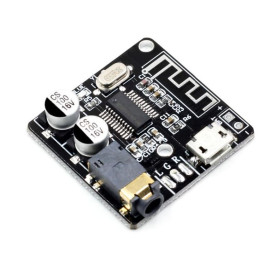
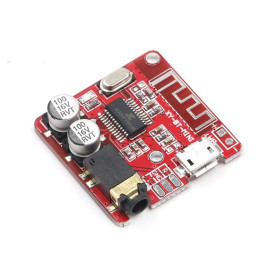
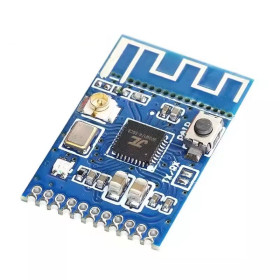
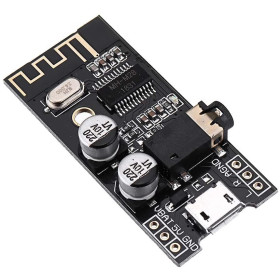
Product images are for informational purposes only and may vary slightly depending on the batch and supplier. Product specifications and prices may be subject to change without notice. We do our best to provide accurate and complete product specifications, but they may not be completely accurate. If you encounter any such situation, please let us know.
The product is intended for specialists and requires qualified and authorized personnel. The product does not include assembly/use instructions . Putting the product into operation by unqualified persons leads to the loss of the warranty according to the Terms and Conditions on the site.
The specified technical parameters (current, power, etc.) represent maximum allowable values under ideal operating conditions. For safe use and optimal lifespan, it is recommended to operate the product continuously at no more than 50% of the specified maximum values.
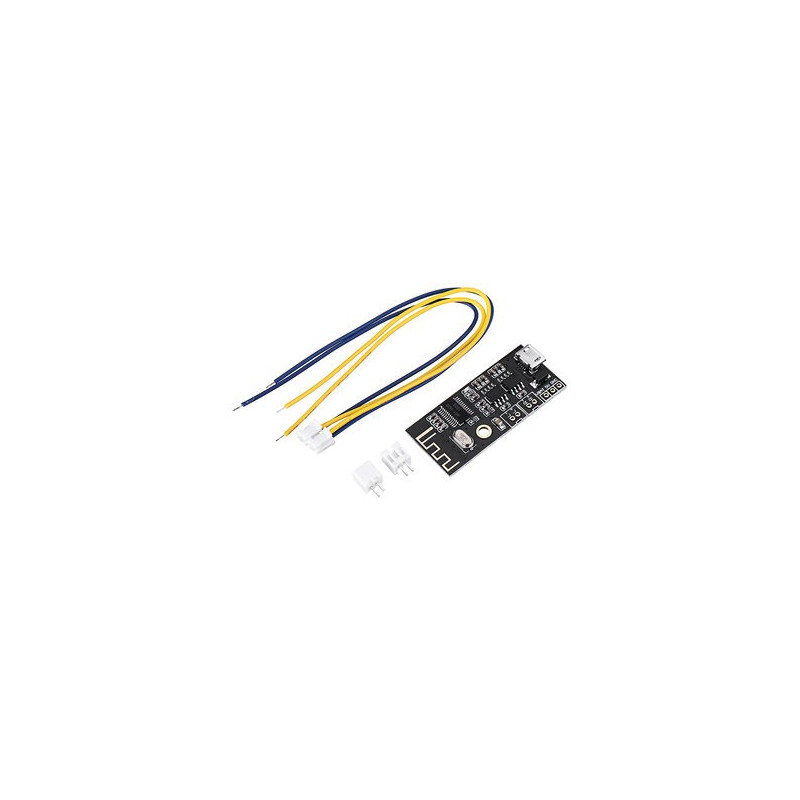
Bluetooth 4.2 BLE audio module, stereo, MH-M38, 2x5W
Bluetooth 4.2 audio receiver module with integrated stereo amplifier, for wireless speakers and homemade audio systems. It delivers 2 x 5 W on 4 ohm speakers, decodes WAV, WMA, FLAC, APE and MP3, has a range of up to 20 m and low power consumption. It is powered via micro USB at 5 V, and the package includes the speaker wires.
Buying this product earns you 0.75 RON in loyalty points.

International fast shipping within EU. Free Shipping for orders above 100 EUR in most EU countries.

We ship from our stock within 24H

You earn points with every order, worth 5%.
The MH-M38 Bluetooth audio module is a stereo receiver with an integrated amplifier. It receives music from a phone, a tablet or a laptop and plays it directly on two speakers, without other boards or external amplifiers. It is suitable for homemade Bluetooth speakers, audio systems for caravans, boats and workshops, small wireless speakers and modifying older audio equipment.
The module supports Bluetooth 4.2 and two-channel stereo playback, with decoding of WAV, WMA, FLAC, APE and MP3. Each channel has its own amplifier, and the output power is 2 x 5 W on 4 ohm speakers. The connection range reaches 20 m in open space, and the consumption is low: 5.5 mA in standby and 20 mA in operation, without an audio signal. The module remembers the last connected device and reconnects automatically.
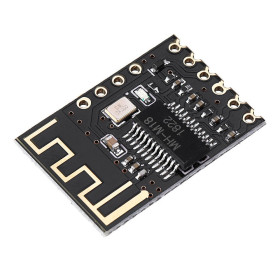
The main features include the Bluetooth antenna printed on the board, the 24.000 MHz crystal, two speaker outputs (L- / L+ and R- / R+), the VBAT, 5V and GND power pads, the micro USB connector with SS34 protection diode and a blue status LED. Power is supplied at 5 V via micro USB or the 5V pad, and for sufficient current at high volume a 5 V / 2 A source is recommended. The package includes two JST-PH 2-pin sockets and two cables with JST-PH connector for connecting the speakers.
Specifications:
Supply voltage: 3.7 - 4.2 V (lithium battery, VBAT pad) or 5 V (micro USB or 5V pad)
Maximum current: 2 A
Standby consumption: 5.5 mA
Operating consumption: 20 mA
Deep sleep consumption: 3 uA
Bluetooth version: 4.2
Supported Bluetooth profiles: HFP V1.7, A2DP V1.2, AVRCP V1.5, AVCTP V1.2, AVDTP V1.2
Decoded formats: WAV / WMA / FLAC / APE / MP3
Audio output: Stereo, 2 channels
Integrated amplifier: Yes
Amplifier output power: 2 x 5 W (4 ohm speakers)
Speaker impedance: 2 - 8 ohms (recommended 4 ohms, 5 W)
Connection range: Up to 20 m in open space
Power connector: Micro USB
Button support: No
Volume adjustment and Mute: No
Wires: Included (2 cables with JST-PH 2-pin connector and 2 JST-PH 2-pin sockets)
Dimensions: 45 x 20.3 mm

Layout:
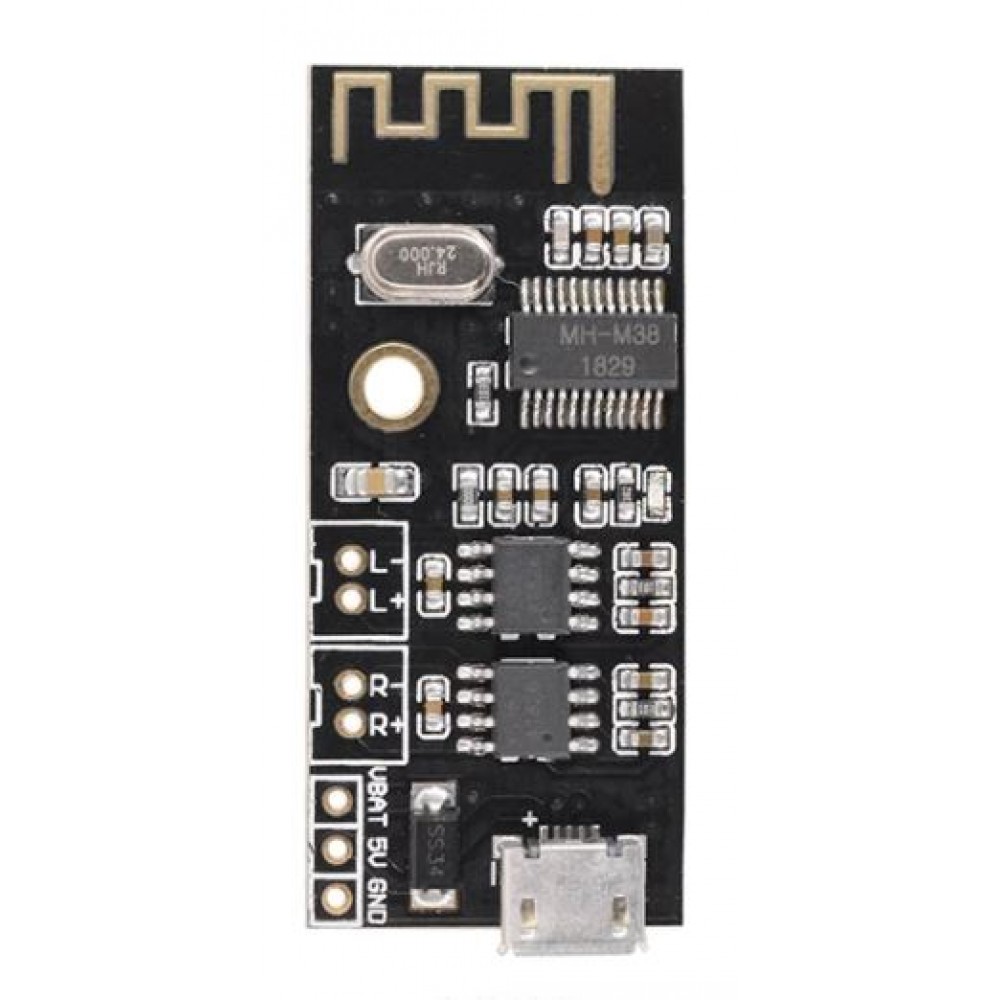
| Element | Function |
|---|---|
| Printed Bluetooth antenna | Antenna of the module. It must be kept away from metal objects and from equipment that emits strong radio signals. |
| MH-M38 Bluetooth circuit | Receives the Bluetooth 4.2 signal, decodes the audio and supplies the stereo signal for the two amplifiers. |
| 24.000 MHz crystal | Provides the clock for the Bluetooth circuit. |
| Two audio amplifiers | One amplifier for each channel, with 5 W power per 4 ohm speaker. They do not connect to another external amplifier. |
| L- / L+ pads | Output for the left speaker. On the back of the board they are marked Lout- and Lout+. |
| R- / R+ pads | Output for the right speaker. On the back of the board they are marked Rout- and Rout+. |
| VBAT pad | Input for a 3.7 - 4.2 V lithium battery. The board has no battery charging circuit. |
| 5V pad | 5 V power input, an alternative to the micro USB connector. |
| GND pad | Power supply ground. |
| Micro USB connector | 5 V power supply. It is located at the end opposite the antenna. |
| SS34 diode | Diode mounted next to the micro USB connector, on the 5 V power path. |
| Blue status LED | Blinks quickly when there is no Bluetooth connection, stays lit continuously when the module is connected and blinks slowly when music is playing. |
| Mounting hole | Plated hole for mounting the board with a screw. |
Pinout:
| Connector | Pin | Function |
|---|---|---|
| Left speaker output | L- | Left speaker negative (Lout-) |
| Left speaker output | L+ | Left speaker positive (Lout+) |
| Right speaker output | R- | Right speaker negative (Rout-) |
| Right speaker output | R+ | Right speaker positive (Rout+) |
| Power supply | VBAT | Lithium battery positive 3.7 - 4.2 V |
| Power supply | 5V | 5 V power supply |
| Power supply | GND | Ground |
| Micro USB | - | 5 V power supply |
Usage:
Solder the 2-pin JST-PH sockets to the L- / L+ and R- / R+ pads, then insert the cables with connectors into the sockets and connect the other end to the speakers.
Use the same color for positive on both speakers, for example yellow for positive and blue for negative, so that they stay in phase.
Connect one 4 ohm, 5 W speaker to each channel. Do not connect the module outputs to another amplifier, do not parallel the outputs and do not link the negative terminals of the two channels together, as the amplifiers can be damaged.
Power the module at 5 V via the micro USB connector or via the 5V and GND pads, observing the polarity, and for high volume use a regulated 5 V / 2 A source and a short, thick micro USB cable.
Use only one power source. If you power the module from a lithium battery, connect it to VBAT and GND and do not use the 5V pad or the micro USB connector at the same time.
Power the module from a mains adapter or from a USB cable without data lines. When connected with a data cable to a computer, the module plays the computer's sound via USB and can no longer be connected via Bluetooth.
After powering up, search for the module in the Bluetooth device list of your phone and connect to it. The blue LED blinks quickly until the connection is made, then stays lit continuously, and when you play music it blinks slowly.
Adjust the volume on the phone or in the playback app, because the module has no buttons or volume and mute control.
For playback without background noise, use short, thick output wires, preferably soldered directly, especially for ground, and avoid wires with connectors.
Keep the antenna away from metal objects and radio transmitters, and when powering from switching power supplies add an LC filter on the power line.
Avoid touching the components with your hands, because the board is unprotected and electrostatic discharges can damage the circuits.
- Supply voltage
- 3.7-4.2 V (lithium battery, VBAT pad) or 5 V (micro USB or 5 V pad)
- Dimensions
- 45 x 20.3 mm
- Maximum current
- 2 A
- Connector type
- Micro USB
- Output type
- Stereo, 2 channels
- Output power
- 2 x 5 W (4 Ω speakers)
- Power consumption
- 20 mA
- Bluetooth
- Bluetooth 4.2
- Standby consumption
- 5.5 mA
- Transmission range
- Up to 20 m in open space
- Output impedance
- 2-8 Ω (recommended 4 Ω, 5 W)
Produs destinat utilizarii in proiecte electronice, automatizari, prototipare, educatie si cercetare.
Produsul trebuie utilizat numai conform specificatiilor tehnice mentionate in descriere si/sau in documentatia produsului.
Avertismente generale de siguranta:
Nu utilizati produsul la tensiuni, curenti sau temperaturi peste valorile specificate.
Montajul si conectarea trebuie realizate de persoane cu cunostinte tehnice minime in domeniul electric/electronic.
Evitati scurtcircuitele, inversarea polaritatii si conectarea gresita a alimentarii.
Nu lasati produsul alimentat nesupravegheat in timpul testelor.
Produsul nu este jucarie si nu este destinat copiilor.
Pentru modulele electronice, se recomanda utilizarea in carcase, panouri sau montaje protejate, dupa caz.
Identificare produs:
Denumirea produsului, codul/SKU-ul si caracteristicile tehnice sunt mentionate in pagina produsului si/sau pe eticheta ambalajului.
Producator / Importator / Distribuitor:
Sigmanortec S.R.L.
Calea Bucuresti nr. 9, Targu Jiu, Gorj, Romania
E-mail: [email protected]
Website: www.sigmanortec.ro
Persoana responsabila in UE:
Sigmanortec S.R.L.
Calea Bucuresti nr. 9, Targu Jiu, Gorj, Romania
E-mail: [email protected]
Documentatie si siguranta:
Pentru informatii suplimentare, fise tehnice, declaratii de conformitate sau instructiuni, ne puteti contacta la [email protected].
Reviews (5) - Review moderation

ok
ok
Cea mai buna solusie pentru o boxa bluetooth.
Isi face exact treaba pentru care a fost gandit
Foarte uaor de folosit
In this tutorial we put the MH-M38 Bluetooth audio module into operation as an independent stereo receiver. We do not use any development board or any program, because the module has its own Bluetooth circuit and its own amplifiers. We power it from a USB adapter and connect two speakers to it.
The module is suitable for homemade Bluetooth speakers, for sound systems in a workshop or a caravan, and for turning a set of ordinary speakers into a wireless playback system.
How it works:
The module's Bluetooth 4.2 circuit connects to the phone and receives the audio stream. It decodes it (the supported formats are WAV, WMA, FLAC, APE and MP3) and sends the stereo signal to two amplifiers, one for each channel. Each amplifier drives a speaker directly, which is why the outputs have two poles, plus and minus, and do not have a common audio ground pin.
The maximum output is 2 x 5 W into 4 ohm speakers. At this power, with an efficiency of about 85 %, the module draws from the source approximately 2 x 5 W / 0.85 = 11.8 W, that is 11.8 W / 5 V = about 2.3 A. For this reason the maximum current of the module is 2 A, and the source must be able to supply at least 2 A. With ordinary music, the average consumption is much lower.
Without an audio signal, the consumption is 5.5 mA in standby and 20 mA with Bluetooth connected, and in deep sleep it drops to 3 uA. The 20 mA value does not include the current drawn by the amplifiers during playback.
Connection:
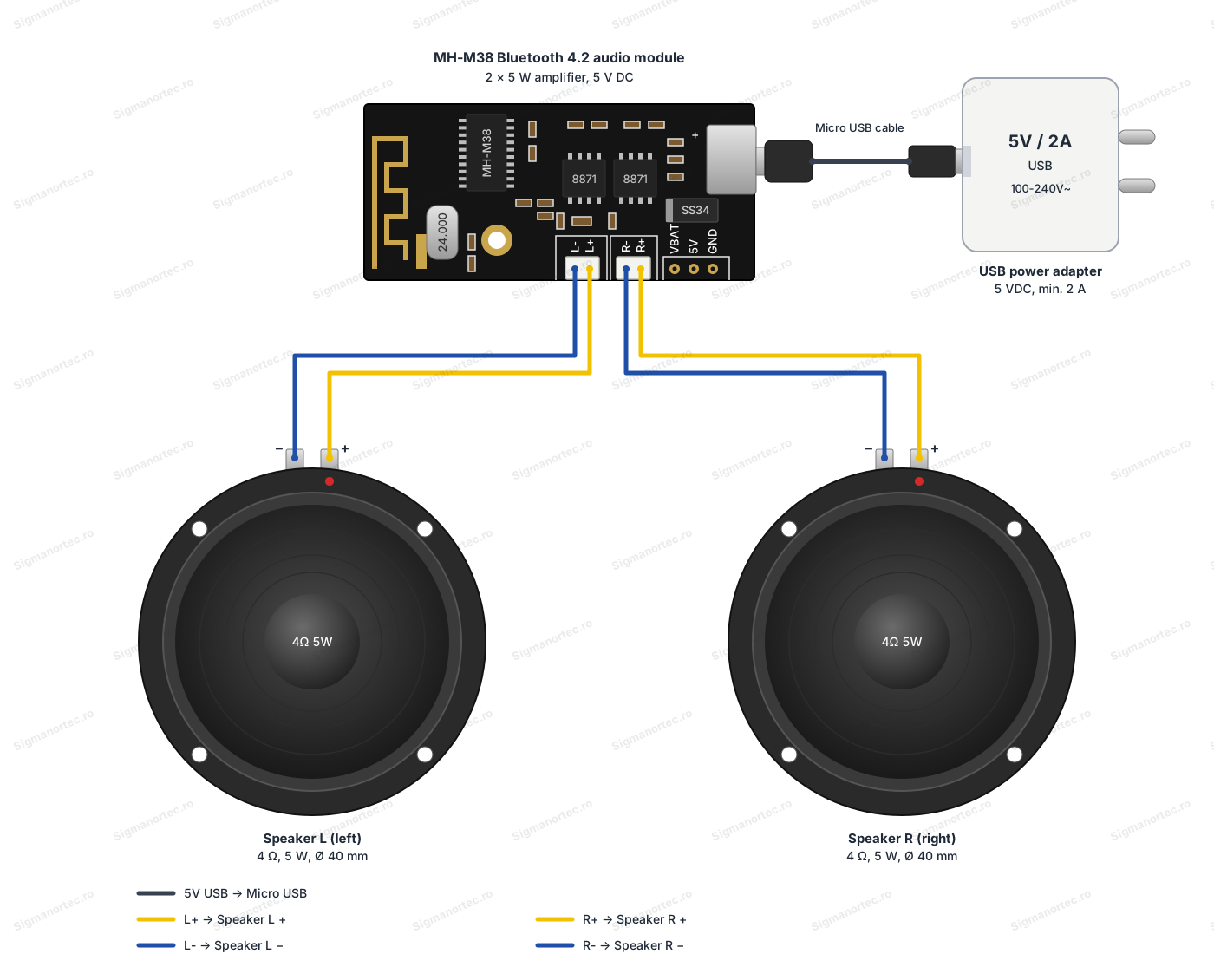
Power the module at 5 V, from a USB adapter of at least 2 A, through a short and thick micro USB cable. Do not apply more than 5 V to the micro USB socket or to the 5V pad. The module does not use logic signals, so no level converter, pull-up resistors or separate logic power supply is needed. The speakers are 4 ohm and 5 W. The 2-pin JST-PH sockets from the package are soldered onto the L and R pads, and then the yellow and blue wires are inserted. The colors do not indicate polarity, so choose yellow for plus and blue for minus on both speakers, so that they stay in phase. The 5V, GND and VBAT pads remain unused when you power the module through micro USB.
| Product pin | Connects to | Role |
|---|---|---|
| Micro USB | USB adapter 5 V / 2 A | 5 V power supply |
| L+ | Left speaker, plus | Left channel audio output |
| L- | Left speaker, minus | Left channel audio output |
| R+ | Right speaker, plus | Right channel audio output |
| R- | Right speaker, minus | Right channel audio output |
Configuration:
The module has no buttons, potentiometers, jumpers or switches, so there is nothing to adjust on the board. The only visible control element is the blue status LED. The volume is adjusted only from the phone or from the playback application.
| Blue LED state | What it means |
|---|---|
| Blinks quickly | Bluetooth is not connected, and the module can be found by the phone. |
| Lit continuously | Bluetooth is connected, but no music is playing. |
| Blinks slowly | Music is playing via Bluetooth. |
Step 1: power the module through micro USB, and the blue LED will start blinking quickly.
Step 2: open Bluetooth on the phone and search for the device named MH-M38.
Step 3: select MH-M38 and wait for the LED to stay lit continuously.
Step 4: start playback. The LED blinks slowly, and the sound comes out of the two speakers. Adjust the volume from the phone.
The module has no settings to store. After a power interruption or after leaving the range, it reconnects automatically to the last connected device, if that device has Bluetooth turned on.
Usage example:
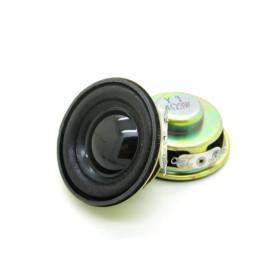
We build a stereo desk speaker. We use two 4 ohm, 5 W speakers with a diameter of 40 mm and a 5 V / 2 A USB adapter with a micro USB cable.
Solder the JST sockets onto the L and R pads, connect the left speaker to L+ and L- and the right one to R+ and R-, with yellow to plus and blue to minus on both. Connect the adapter to the micro USB socket. The LED blinks quickly.
Connect the phone to MH-M38, set the phone volume to about half and start a song. The LED blinks slowly, and the music is heard in stereo. Then increase the volume gradually. If the sound distorts or the module resets on loud passages, lower the volume or switch to a more powerful power supply.
Common problems:
The phone does not find the module or cannot connect to it. The usual cause is powering it from a computer USB port through a data cable, in which case the module works as a USB sound card and Bluetooth is no longer available. Use a mains adapter or a USB cable without data lines.
The module resets or the sound cuts out at high volume. The source cannot supply the required current, or the cable is too long and thin. Use an adapter of at least 2 A and a short, thick micro USB cable.
Noise or background hum can be heard. It usually comes from long wires or from a ground with interference. Shorten the output wires, use thick wires, preferably soldered, and add an LC filter on the power supply if you use a switching power supply.
One channel does not sound or the sound is distorted. Check that the negative poles of the two channels are not connected together and that the outputs are not in parallel or connected to another amplifier. These connections can damage the amplifiers.
The Bluetooth connection drops or the range is short. The antenna is affected by metal objects and by nearby radio transmitters. Move the module away from them and mount it with the antenna unobstructed.
Limitations and tips:
The module has no buttons, volume or mute control, so the volume can only be adjusted from the audio source. The range of up to 20 m applies in open space and decreases indoors or near metal objects.
The amplifiers are designed for 4 ohm, 5 W speakers, and at 5 V they deliver 2 x 5 W. Do not connect the outputs to another amplifier. The VBAT pad accepts a 3.7 - 4.2 V lithium battery, but the board has no charging circuit, so the battery must be charged separately.
With the module you can build a stereo Bluetooth speaker, a sound system for a caravan or boat, or a set of speakers for a workshop. The board is unprotected, so mount it in an enclosure and avoid touching the components.