

Product images are for informational purposes only and may vary slightly depending on the batch and supplier. Product specifications and prices may be subject to change without notice. We do our best to provide accurate and complete product specifications, but they may not be completely accurate. If you encounter any such situation, please let us know.
The product is intended for specialists and requires qualified and authorized personnel. The product does not include assembly/use instructions . Putting the product into operation by unqualified persons leads to the loss of the warranty according to the Terms and Conditions on the site.
The specified technical parameters (current, power, etc.) represent maximum allowable values under ideal operating conditions. For safe use and optimal lifespan, it is recommended to operate the product continuously at no more than 50% of the specified maximum values.
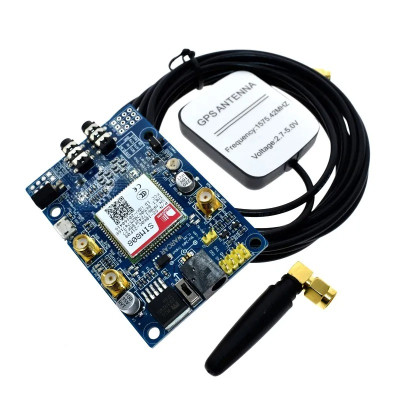
SIM808 development module, GSM-GPRS-GPS-Bluetooth, 5–25V
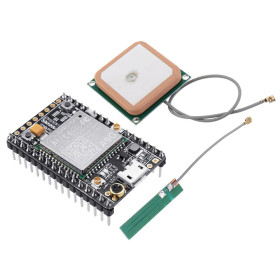
Development board for communications and localization, ideal for IoT and telemetry projects. It offers quad-band GSM GPRS, precise GPS with fast fix, and Bluetooth, with control via AT commands over UART with autobaud. The UART logic level is selectable at 1.25V, 3.3V, or 5V via VMCU, compatible with Arduino, STM32, ESP32, and Raspberry Pi. Includes GSM and GPS antennas.
Shipping by Thursday 22 October
Buying this product earns you 6.63 RON in loyalty points.

International fast shipping within EU. Free Shipping for orders above 100 EUR in most EU countries.

We ship from our stock within 24H

You earn points with every order, worth 5%.
The SIM808 development module integrates the SIM808 chip from SIMCom, providing quad-band GSM/GPRS communication (850/900/1800/1900 MHz), a GPS receiver with 22 tracking channels and 66 acquisition channels, as well as Bluetooth connectivity. It is compatible with Arduino, STM32, ESP32, and Raspberry Pi, thanks to the VMCU pin that allows UART logic-level matching to 1.25V, 3.3V, or 5V depending on the voltage applied by the host.
The internal GPS receiver is based on the MT3337 chip, with a sensitivity of -165dBm in tracking mode and -148dBm at cold start, offering an accuracy of approximately 2.5m. GPS fix time is approximately 32 seconds at cold start, 5 seconds at warm start, and 1 second at hot start. The module supports UART communication with automatic baud rate setting and is controlled via standard AT commands (3GPP TS 27.007, 27.005) and SIMCom extended AT commands.
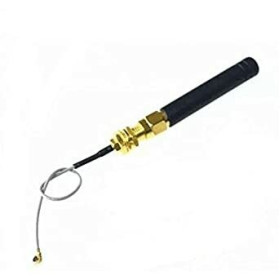
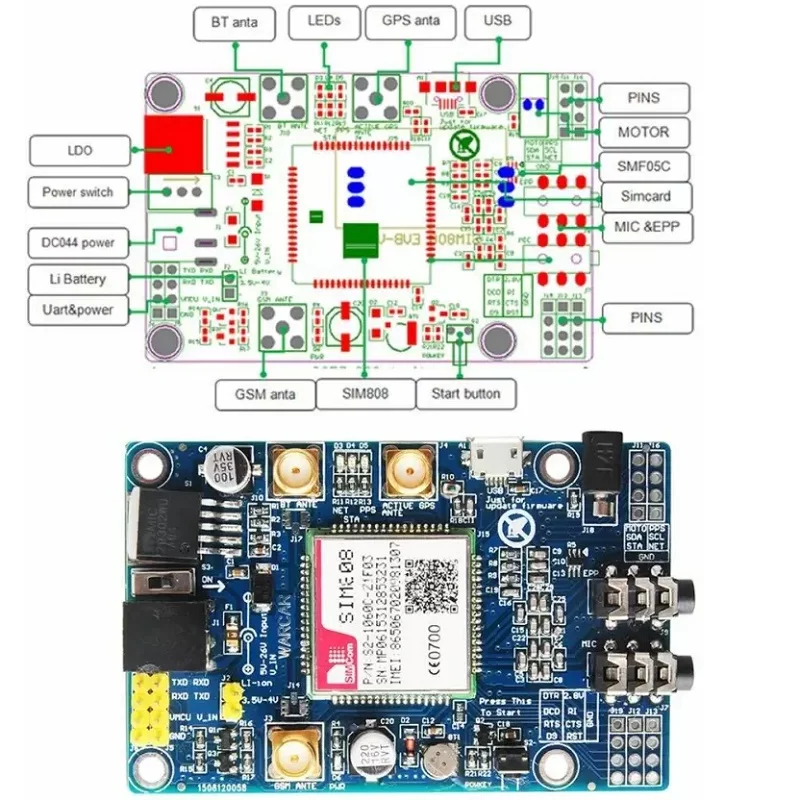
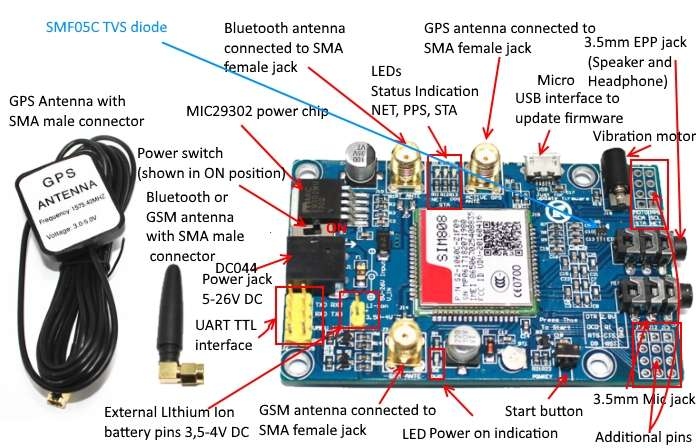
The board features three power supply options: a 5.5x2.1mm DC jack (DC044), the V_IN pin (5-25V, recommended 9V/2A), and a JST connector for a Li-Ion battery (3.5-4.2V). A switch turns the main power on or off, and a PWRKEY button (long press of about 2 seconds) starts the module. Operating status is indicated by three LEDs: power (PWR), network (NET), and GPS. Headphone and microphone outputs are available, as well as support for an external 32-ohm speaker with an electret microphone, enabling voice calls. Two sets of SMA connectors (for external GSM and GPS antennas) and two IPX ports (for integration into metal enclosures) complete the hardware features. The GSM antenna and GPS antenna are included in the package. The Bluetooth antenna must be purchased separately.
The USB interface is intended exclusively for firmware updates and debugging, not for UART communication.
Specifications:
Chip: SIM808 (SIMCom)
Internal GPS chip: MT3337
GSM bands: Quad-band 850/900/1800/1900 MHz (2G)
GPRS: Multi-slot Class 12/10, Class B
GPS tracking channels: 22 channels
GPS acquisition channels: 66 channels
GPS tracking sensitivity: -165dBm
GPS cold start sensitivity: -148dBm
GPS cold start fix time: ~32s
GPS warm start fix time: ~5s
GPS hot start fix time: ~1s
GPS accuracy: ~2.5m
GSM transmit power: Class 4 — 2W at 850/900 MHz, Class 1 — 1W at 1800/1900 MHz
GSM mode current consumption: 100mA at 7V
Supply voltage (V_IN / DC044): 5 – 25 VDC (recommended 9V, 2A)
Li-Ion battery voltage (BAT): 3.5 – 4.2 VDC
UART logic level: Adjustable via VMCU: 1.25V / 3.3V / 5V
SMA antenna connectors: GSM, GPS, Bluetooth
IPX ports: 2 (GSM, GPS)
SIM slot: Micro SIM, push-push
Audio: Headphone/microphone output, external 32-ohm speaker, electret microphone
Operating temperature: -40°C – 85°C
Dimensions: 80 x 50 x 14 mm
Weight: 30g
Layout:
Usage:
Connect the included GSM antenna and GPS antenna to the corresponding female SMA jacks on the board. If you want to use Bluetooth, purchase and connect a separate Bluetooth antenna to the dedicated female SMA jack.
Insert an active MicroSIM card (2G) into the push-push slot.
Connect a 5-25V power supply (recommended 9V/2A) to the DC044 jack. Alternatively, you can power the board through the external Li-Ion battery pins (3.5-4V).
Set the power switch to ON. The PWR LED will light up, confirming power.
Press the START button (PWRKEY) for about 2 seconds. Wait for the NET LED to blink slowly (once every 3 seconds), indicating GSM network registration.
Set the logic voltage required by the host platform (5V for Arduino UNO, 3.3V for STM32 or ESP32) and connect the VMCU pin to the corresponding voltage.
Make the UART connections: TXD (module) → host RX, RXD (module) → host TX, GND → host GND.
Open a serial terminal at 9600 baud (or 115200) and send the AT command. The module should respond with OK.
Essential AT commands:
AT+CSQ — signal quality
AT+CREG? — network status (1 or 5 = registered)
AT+GPS=1 — start GPS receiver
AT+GPSRD=5 — NMEA data every 5 seconds
AT+CMGF=1 — SMS text mode
AT+CMGS="+40xxxxxxxxx" — send SMS
AT+BTPOWER=1 — turn on Bluetooth
To turn off: press the START button (PWRKEY) again for about 2 seconds. The main switch can be set to OFF to completely cut power.
Arduino Connection Example:
.jpg)
Replace the Serial TX and RX pins with those defined in your own code.
Package Contents:
1x SIM808 Module
1x GSM Antenna
1x GPS Antenna
- tension
- AD
- Supply Voltage
- 5
- Maximum Input Voltage
- 25
- Chipset
- SIM808
- Communication interfaces
- GSM, GPRS, GPS, Bluetooth
Produs destinat utilizarii in proiecte electronice, automatizari, prototipare, educatie si cercetare.
Produsul trebuie utilizat numai conform specificatiilor tehnice mentionate in descriere si/sau in documentatia produsului.
Avertismente generale de siguranta:
Nu utilizati produsul la tensiuni, curenti sau temperaturi peste valorile specificate.
Montajul si conectarea trebuie realizate de persoane cu cunostinte tehnice minime in domeniul electric/electronic.
Evitati scurtcircuitele, inversarea polaritatii si conectarea gresita a alimentarii.
Nu lasati produsul alimentat nesupravegheat in timpul testelor.
Produsul nu este jucarie si nu este destinat copiilor.
Pentru modulele electronice, se recomanda utilizarea in carcase, panouri sau montaje protejate, dupa caz.
Identificare produs:
Denumirea produsului, codul/SKU-ul si caracteristicile tehnice sunt mentionate in pagina produsului si/sau pe eticheta ambalajului.
Producator / Importator / Distribuitor:
Sigmanortec S.R.L.
Calea Bucuresti nr. 9, Targu Jiu, Gorj, Romania
E-mail: [email protected]
Website: www.sigmanortec.ro
Persoana responsabila in UE:
Sigmanortec S.R.L.
Calea Bucuresti nr. 9, Targu Jiu, Gorj, Romania
E-mail: [email protected]
Documentatie si siguranta:
Pentru informatii suplimentare, fise tehnice, declaratii de conformitate sau instructiuni, ne puteti contacta la [email protected].
// SIM808 AT Test — Arduino UNO
// TXD(module) → pin 10, RXD(module) → pin 11, VMCU → 5V
#include <SoftwareSerial.h>
SoftwareSerial sim808(10, 11); // RX, TX
void setup() {
Serial.begin(9600);
sim808.begin(9600);
delay(3000);
sim808.println("AT"); // Basic check
delay(1000);
sim808.println("AT+CSQ"); // Signal quality
delay(1000);
sim808.println("AT+CREG?"); // Network registration
}
void loop() {
if (sim808.available()) Serial.write(sim808.read());
if (Serial.available()) sim808.write(Serial.read());
}