
Product images are for informational purposes only and may vary slightly depending on the batch and supplier. Product specifications and prices may be subject to change without notice. We do our best to provide accurate and complete product specifications, but they may not be completely accurate. If you encounter any such situation, please let us know.
The product is intended for specialists and requires qualified and authorized personnel. The product does not include assembly/use instructions . Putting the product into operation by unqualified persons leads to the loss of the warranty according to the Terms and Conditions on the site.
The specified technical parameters (current, power, etc.) represent maximum allowable values under ideal operating conditions. For safe use and optimal lifespan, it is recommended to operate the product continuously at no more than 50% of the specified maximum values.
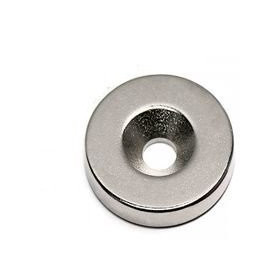
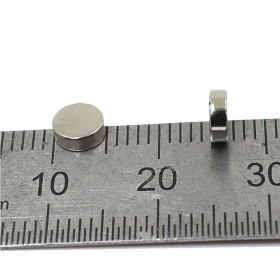
Permanent neodymium magnet 5x3, cylindrical, diameter 5 mm, thickness 3 mm
Ideal for quick and precise fixing in technical applications, this neodymium magnet offers high attraction force in a compact format. It measures 5x3 mm, is made of a permanent material with good long-term stability, integrates easily into small assemblies and is suitable for automation, electronics, sensors, fixings and DIY projects.
Buying this product earns you 0.05 RON in loyalty points.

International fast shipping within EU. Free Shipping for orders above 100 EUR in most EU countries.

We ship from our stock within 24H

You earn points with every order, worth 5%.
The 5x3 permanent neodymium magnet is a small cylindrical magnet with a diameter of 5 mm and a thickness of 3 mm. It creates a strong magnetic field in a small space and needs no power supply. It is suitable for actuating Hall sensors and reed switches, for magnetic closures on enclosures and doors, for holding small parts, for position indicators and for 3D-printed prototypes.
The magnet is made of a permanently magnetized alloy of neodymium, iron and boron. The north pole and the south pole are usually located on the two flat faces of the cylinder. The attraction force is high in direct contact with an iron or steel part and drops quickly as the distance increases. For detection, the distance between the magnet and the sensor matters, and for fixing, the contact surface matters.
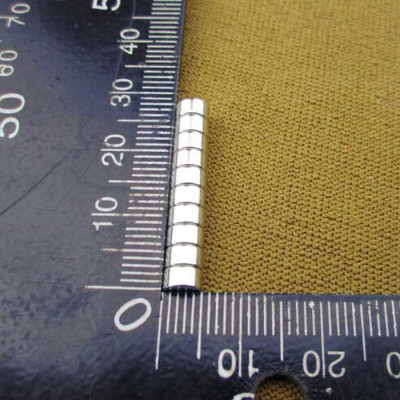
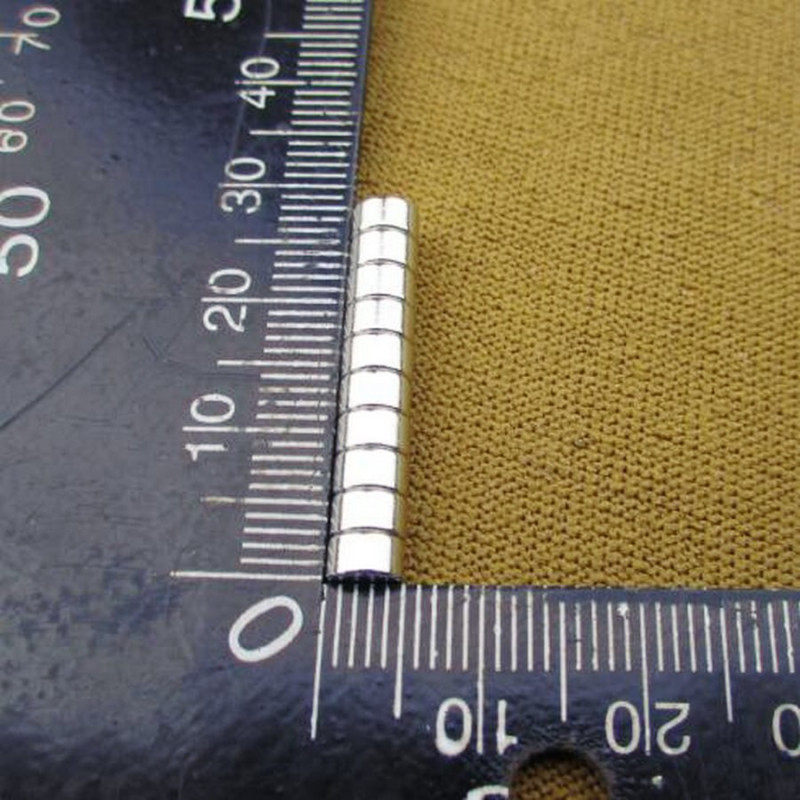
The main features include the cylindrical shape, the small size of 5 x 3 mm and operation without power, without pins and without electrical connections. Ten magnets stacked on top of each other form a column of 30 mm.
Specifications:
Type: Permanent magnet
Material: Neodymium, iron, boron
Shape: Cylinder
Diameter: 5 mm
Thickness: 3 mm
Dimensions: 5 x 3 mm
Usage:
Identify the poles before mounting. Bring a compass close to one of the flat faces. The end of the needle that points north is attracted to the south pole of the magnet. Mark the identified face, for example with a dot of marker on the part in which you mount the magnet.
Choose the mounting method. For flush mounting, make a recess with a diameter of 5 mm and a depth of 3 mm, in which the magnet stays level with the surface. For flat surfaces, use cyanoacrylate or epoxy adhesive, after degreasing both surfaces with isopropyl alcohol. Let the adhesive cure completely before use.
For temporary holding, place the magnet directly on an iron or steel part. Aluminium, copper or plastic parts are not attracted.
For detection with a Hall sensor or reed switch, check the operation with the magnet held in your hand, in the final position, before fixing it. Start from a gap of about 2 mm between the magnet and the sensor. Then gradually increase the distance up to the limit at which the sensor still switches reliably, and choose the final working distance clearly below this limit. If the sensor does not react, turn the magnet so that the opposite face is toward the sensor.
Separate magnets stuck together by sliding them sideways, not by pulling along the axis. Bring them slowly to the mounting place, because they can strike each other and break if they snap suddenly toward one another. Wear protective glasses when working with several magnets.
Do not overheat the magnet, for example by soldering with an iron nearby, because it loses strength. Keep the magnet away from data carriers, cards and implanted medical devices.
- Dimensions
- 5 x 3 mm
- Material
- Neodymium, iron, boron
- Type
- Permanent magnet
- Thickness
- 3 mm
- Diameter
- 5 mm
- Shape
- Cylinder
Produs destinat utilizarii in proiecte electronice, automatizari, prototipare, educatie si cercetare.
Produsul trebuie utilizat numai conform specificatiilor tehnice mentionate in descriere si/sau in documentatia produsului.
Avertismente generale de siguranta:
Nu utilizati produsul la tensiuni, curenti sau temperaturi peste valorile specificate.
Montajul si conectarea trebuie realizate de persoane cu cunostinte tehnice minime in domeniul electric/electronic.
Evitati scurtcircuitele, inversarea polaritatii si conectarea gresita a alimentarii.
Nu lasati produsul alimentat nesupravegheat in timpul testelor.
Produsul nu este jucarie si nu este destinat copiilor.
Pentru modulele electronice, se recomanda utilizarea in carcase, panouri sau montaje protejate, dupa caz.
Identificare produs:
Denumirea produsului, codul/SKU-ul si caracteristicile tehnice sunt mentionate in pagina produsului si/sau pe eticheta ambalajului.
Producator / Importator / Distribuitor:
Sigmanortec S.R.L.
Calea Bucuresti nr. 9, Targu Jiu, Gorj, Romania
E-mail: [email protected]
Website: www.sigmanortec.ro
Persoana responsabila in UE:
Sigmanortec S.R.L.
Calea Bucuresti nr. 9, Targu Jiu, Gorj, Romania
E-mail: [email protected]
Documentatie si siguranta:
Pentru informatii suplimentare, fise tehnice, declaratii de conformitate sau instructiuni, ne puteti contacta la [email protected].
Reviews (4) - Review moderation

super ok
BUN
Produse f.bune
Ok ! 5*****,
The 5x3 neodymium magnet is a small, cylindrical permanent magnet with a diameter of 5 mm and a thickness of 3 mm. It is used in electronic and mechanical projects that need a strong magnetic field in a limited space. Examples: actuating Hall sensors and reed switches, magnetic closures for enclosures and doors, holders for small parts, position indicators and 3D printed prototypes.
The product has no power supply, controller or program, so this tutorial only explains how to choose the orientation, how to fix the magnet and how to test it in an application.
How it works:
The magnet is made of a neodymium, iron and boron alloy, permanently magnetized. It creates around itself a magnetic field with a north pole and a south pole, without consuming energy. In a cylindrical magnet of this type, the poles are usually located on the two flat faces. That is why the orientation must be checked before mounting, as described in the Configuration section.
The volume of a cylinder is calculated with the formula V = pi x r x r x h. For this magnet, r = 2.5 mm and h = 3 mm, so V = 3.14 x 2.5 x 2.5 x 3 = approximately 59 mm3, that is 0.059 cm3. The density of sintered neodymium alloys is around 7.5 g/cm3, so the mass of the magnet is approximately 0.44 g. It is small and light, but its field is sufficient for many detection and fixing applications.
The attractive force drops very quickly with distance. A magnet strongly attracts an iron object in contact, but at a few millimeters the force is already much smaller. That is why, for sensors, the distance between the magnet and the sensor matters, and for fixing, the contact surface matters. Ten magnets stacked on top of each other have a length of 30 mm, that is 10 x 3 mm.
Connection:
The magnet has no pins and is not connected electrically. It needs no supply voltage, no logic levels and no resistors. It acts at a distance on other components, for example a Hall sensor, a reed switch or an iron part.
| Product pin | Connects to | Role |
|---|---|---|
| No pins | Nothing | Acts through the magnetic field on the sensors or iron parts located nearby. |
Configuration:
Step 1: identify the poles. Bring a compass close to one of the flat faces of the magnet. The end of the compass needle that points north is attracted to the south pole of the magnet. Mark the face you identified, for example with a dot of marker on the packaging or on the part in which you mount it. If you do not have a compass, you can use another magnet that is already marked. Faces that repel each other have the same pole.
Step 2: choose the fixing method from the table below.
| Method | When it is used | Notes |
|---|---|---|
| Recess with a diameter of 5 mm | Embedded mounting in plastic, wood or 3D printed parts | A recess with a depth of 3 mm keeps the magnet flush with the surface. For a tight fit with no play, the recess can be slightly smaller in diameter than the magnet, and the magnet is inserted with a light press fit. |
| Cyanoacrylate or epoxy adhesive | Fixing on flat surfaces | Degrease the surfaces with isopropyl alcohol and let the adhesive cure completely before use. |
| Direct attraction | Temporary holding on an iron or steel part | No adhesive needed. Parts made of aluminum, copper, plastic or austenitic stainless steel are not attracted. |
Step 3: separate the magnets carefully. If you have received several magnets stuck together, do not pull them apart along the axis. Slide them sideways, one relative to the other, until they separate. Bring the magnets to the mounting location carefully, because they can strike each other and break if they suddenly jump toward one another.
Step 4: keep the position and orientation. When mounting next to a sensor or a contact, fix the magnet permanently only after you have verified the operation with the magnet held in your hand, in the final position.
Usage example:
Example: detecting the closing of a cabinet door with a reed switch or a Hall sensor. The magnet is mounted in the door panel, and the sensor in the frame, opposite it.
Mark the south pole of the magnet with the compass, as described above. Fix the sensor on the frame and connect it to its circuit, following the sensor documentation. Bring the magnet close to the sensor, with the flat face toward the sensor, starting from a gap of approximately 2 mm. The reed switch must close the circuit, which you can see with a multimeter set to continuity. A Hall sensor must change the state of its output. Then gradually increase the distance up to the limit at which the sensor still switches reliably. The final working distance must be clearly below this limit, so that there is a margin.
If the sensor does not switch, turn the magnet so the opposite face points toward the sensor. Bipolar or unipolar Hall sensors react differently to the two poles. When the switching is stable, drill a recess with a diameter of 5 mm and a depth of 3 mm in the door panel and glue the magnet with adhesive, with the marked face oriented toward the sensor.
Common problems:
The sensor does not react to the magnet. The usual cause is the wrong pole or a distance that is too large. Solution: turn the magnet so the other face points toward the sensor and reduce the gap between them. Also check the position of the sensor, because many reed switches respond better to a field parallel to their body.
The magnet comes off the surface. The cause is usually a dirty or greasy surface, or the wrong adhesive. Solution: clean both surfaces with isopropyl alcohol, use a cyanoacrylate or epoxy adhesive and wait for it to cure completely.
The magnet has cracked or chipped. The cause is striking another magnet or an iron part when it was suddenly attracted. Neodymium alloys are hard, but brittle. Solution: keep the magnets at a distance, bring them slowly to the mounting location and wear protective glasses when working with several magnets.
The magnet has lost strength. The cause can be strong heating, for example soldering with an iron nearby or leaving it next to a heat source. Solution: keep the magnet away from heat sources. A magnet that has been overheated does not regain its original strength and must be replaced.
The magnets are stuck together and difficult to separate. The cause is the attraction between the flat faces in contact. Solution: slide them sideways, one relative to the other, instead of pulling them along the axis.
Limitations and tips:
The magnet is small, so its range is on the order of a few millimeters. For larger distances, use a more sensitive sensor or several magnets stacked on top of each other, keeping in mind that ten magnets form a column of 30 mm.
Neodymium is brittle and sensitive to heat, so avoid impacts, forced pressing and soldering nearby. Keep the magnets away from cards, data carriers and implanted medical devices.
With the same type of magnet you can build magnetic closures for enclosures, door or lid sensors, position indicators for moving parts and holders for tools or small iron parts.