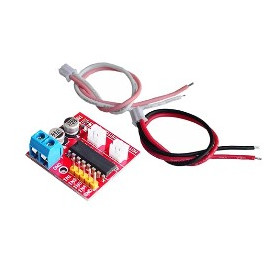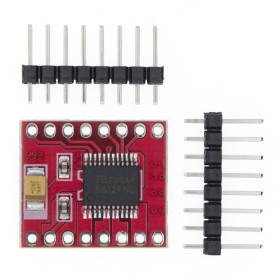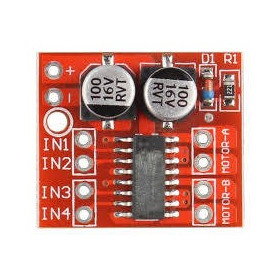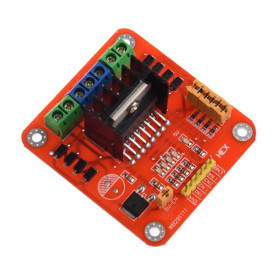

Product images are for informational purposes only and may vary slightly depending on the batch and supplier. Product specifications and prices may be subject to change without notice. We do our best to provide accurate and complete product specifications, but they may not be completely accurate. If you encounter any such situation, please let us know.
The product is intended for specialists and requires qualified and authorized personnel. The product does not include assembly/use instructions . Putting the product into operation by unqualified persons leads to the loss of the warranty according to the Terms and Conditions on the site.
The specified technical parameters (current, power, etc.) represent maximum allowable values under ideal operating conditions. For safe use and optimal lifespan, it is recommended to operate the product continuously at no more than 50% of the specified maximum values.
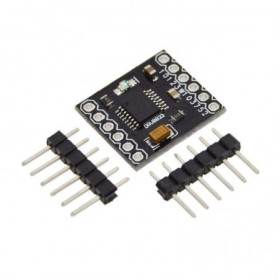
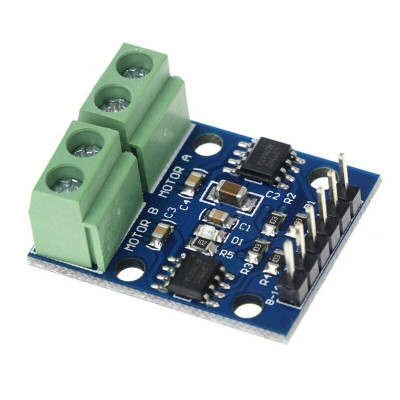
DC motor driver module, stepper, L9110S, H-bridge, 2.5V-12V
Dual H-bridge module for direction and speed control, ideal for two DC motors or one stepper motor, compatible with Arduino and other development boards. It uses the L9110S driver, operates at 2.5-12V, supports up to 0.8A per channel, has 6 pins for quick connection and compact 28 x 21 mm PCB with 3 mm mounting holes.
Shipping by Thursday 22 October
Buying this product earns you 0.21 RON in loyalty points.

International fast shipping within EU. Free Shipping for orders above 100 EUR in most EU countries.

We ship from our stock within 24H

You earn points with every order, worth 5%.
The H-bridge with L9110S motor driver is a compact and efficient module, compatible with Arduino and other development boards, designed for controlling two DC motors or one stepper motor. It allows control of direction and speed for up to 2 DC motors, making it a practical choice for robotics, automation, and electronic prototyping projects.
It operates at voltages between 2.5V and 12V and can deliver a maximum current of up to 0.8A, making it suitable for small and medium-sized motors. The small board format and the 6 connection pins allow easy integration into compact assemblies, and the 3 mm mounting holes help securely fix the module in the project.
Specifications:
Operating voltage: 2.5-12V
Chip: L9110S
Maximum operating current: 0.8A
Mounting hole diameter: 3 mm
Number of pins: 6
PCB dimensions mm: 28 x 21 mm
Compatibility: Arduino and other development boards
Function: control of 2 DC motors or 1 stepper motor
Pinout:
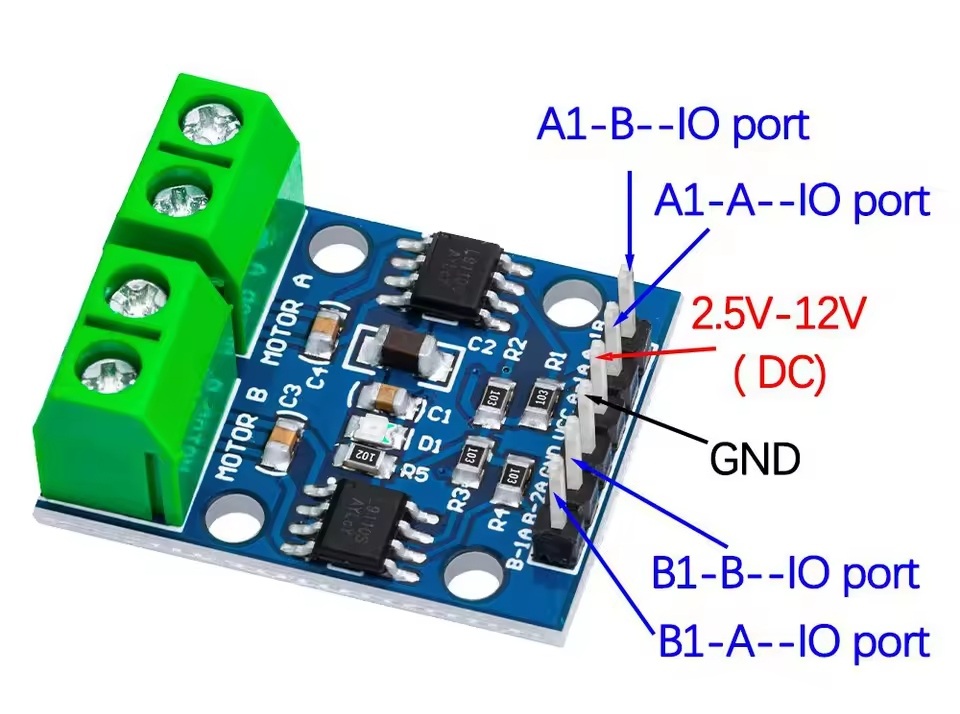
| Pin | Function | Description |
|---|---|---|
| B-IA | Control input | Controls motor B |
| B-IB | Control input | Controls motor B |
| GND | Ground | Common ground for module and control board |
| VCC | Power supply | Power supply voltage 2.5V - 12V DC |
| A-IA | Control input | Controls motor A |
| A-IB | Control input | Controls motor A |
Usage:
The module is used for motor control in electronic projects by connecting the motors to the dedicated terminals and the control pins to the development board. It can be used to change the rotation direction and adjust speed through appropriate control signals. It is recommended for applications such as mobile robots, automatic mechanisms, educational systems, and laboratory experiments where simple and efficient motor control is needed.
Motor Outputs:
| Terminal | Function | Description |
|---|---|---|
| MOTOR A | Motor output | Connection for DC motor A |
| MOTOR B | Motor output | Connection for DC motor B |
Pin Combinations:
| Pin combination | Result |
|---|---|
| A-IA: HIGH, A-IB: LOW | Motor A in one direction |
| A-IA: LOW, A-IB: HIGH | Motor A in opposite direction |
| A-IA: LOW, A-IB: LOW | Motor A stopped |
| B-IA: HIGH, B-IB: LOW | Motor B in one direction |
| B-IA: LOW, B-IB: HIGH | Motor B in opposite direction |
| B-IA: LOW, B-IB: LOW | Motor B stopped |
Important: Do not apply rotation signals in both directions simultaneously as the module will short circuit and burn out instantly.
Arduino Example:
Arduino connections:
| L9110S Module | Arduino UNO | Function |
|---|---|---|
| VCC | 5V or external power supply | Module power supply |
| GND | GND | Common ground |
| A-IA | D5 | Motor A control |
| A-IB | D6 | Motor A control |
| B-IA | D9 | Motor B control |
| B-IB | D10 | Motor B control |
Motor connections:
| Module terminal | Connection |
|---|---|
| MOTOR A | DC Motor 1 |
| MOTOR B | DC Motor 2 |
- Supply Voltage
- 2.5
- Maximum Input Voltage
- 12
- Input Voltage Type
- “DC” in Romanian can mean **“de ce”**, which translates to **“why”** in English.
Produs destinat utilizarii in proiecte electronice, automatizari, prototipare, educatie si cercetare.
Produsul trebuie utilizat numai conform specificatiilor tehnice mentionate in descriere si/sau in documentatia produsului.
Avertismente generale de siguranta:
Nu utilizati produsul la tensiuni, curenti sau temperaturi peste valorile specificate.
Montajul si conectarea trebuie realizate de persoane cu cunostinte tehnice minime in domeniul electric/electronic.
Evitati scurtcircuitele, inversarea polaritatii si conectarea gresita a alimentarii.
Nu lasati produsul alimentat nesupravegheat in timpul testelor.
Produsul nu este jucarie si nu este destinat copiilor.
Pentru modulele electronice, se recomanda utilizarea in carcase, panouri sau montaje protejate, dupa caz.
Identificare produs:
Denumirea produsului, codul/SKU-ul si caracteristicile tehnice sunt mentionate in pagina produsului si/sau pe eticheta ambalajului.
Producator / Importator / Distribuitor:
Sigmanortec S.R.L.
Calea Bucuresti nr. 9, Targu Jiu, Gorj, Romania
E-mail: [email protected]
Website: www.sigmanortec.ro
Persoana responsabila in UE:
Sigmanortec S.R.L.
Calea Bucuresti nr. 9, Targu Jiu, Gorj, Romania
E-mail: [email protected]
Documentatie si siguranta:
Pentru informatii suplimentare, fise tehnice, declaratii de conformitate sau instructiuni, ne puteti contacta la [email protected].
Reviews (1) - Review moderation

const int A_IA = 5;
const int A_IB = 6;
const int B_IA = 9;
const int B_IB = 10;
void stopMotorA() {
digitalWrite(A_IA, LOW);
digitalWrite(A_IB, LOW);
}
void stopMotorB() {
digitalWrite(B_IA, LOW);
digitalWrite(B_IB, LOW);
}
void motorAForward(int speedValue) {
analogWrite(A_IA, speedValue);
digitalWrite(A_IB, LOW);
}
void motorABackward(int speedValue) {
digitalWrite(A_IA, LOW);
analogWrite(A_IB, speedValue);
}
void motorBForward(int speedValue) {
analogWrite(B_IA, speedValue);
digitalWrite(B_IB, LOW);
}
void motorBBackward(int speedValue) {
digitalWrite(B_IA, LOW);
analogWrite(B_IB, speedValue);
}
void setup() {
pinMode(A_IA, OUTPUT);
pinMode(A_IB, OUTPUT);
pinMode(B_IA, OUTPUT);
pinMode(B_IB, OUTPUT);
stopMotorA();
stopMotorB();
}
void loop() {
motorAForward(200);
motorBForward(200);
delay(2000);
stopMotorA();
stopMotorB();
delay(500);
motorABackward(200);
motorBBackward(200);
delay(2000);
stopMotorA();
stopMotorB();
delay(1000);
}