Product images are for informational purposes only and may vary slightly depending on the batch and supplier. Product specifications and prices may be subject to change without notice. We do our best to provide accurate and complete product specifications, but they may not be completely accurate. If you encounter any such situation, please let us know.
The product is intended for specialists and requires qualified and authorized personnel. The product does not include assembly/use instructions . Putting the product into operation by unqualified persons leads to the loss of the warranty according to the Terms and Conditions on the site.
The specified technical parameters (current, power, etc.) represent maximum allowable values under ideal operating conditions. For safe use and optimal lifespan, it is recommended to operate the product continuously at no more than 50% of the specified maximum values.
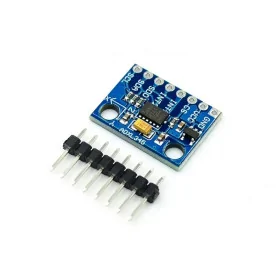
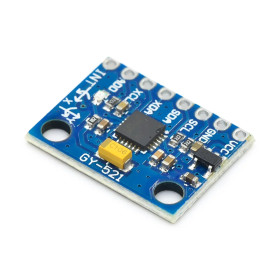
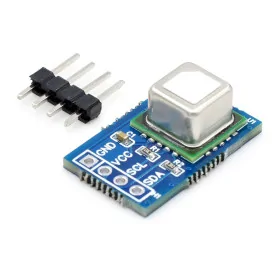
ADXL345 accelerometer module, I2C/SPI, 3.3-5V
Module with ADXL345 for measuring acceleration and tilt on 3 axes, suitable for Arduino and other development boards. Offers flexible communication via I2C or SPI, operates at 3.3-5V and includes RT9161 regulator for stable power supply in noisy environments. Compact format 28 x 14 mm, easy to integrate into control, monitoring and orientation projects.
Shipping by Thursday 22 October
Buying this product earns you 0.26 € in loyalty points.

International fast shipping within EU. Free Shipping for orders above 100 EUR in most EU countries.

We ship from our stock within 24H

You earn points with every order, worth 5%.
The ADXL345 3-axis accelerometer sensor module is a compact and efficient solution for measuring tilt, acceleration, and angle in Arduino-based projects and other development boards. It allows motion monitoring on three axes and can be used in robotics, automation, vibration detection, stabilization systems, portable devices, and educational or test projects.
The module is factory hard-configured for the I2C interface, making it easy to integrate into most common projects. To use the SPI interface, the R4 resistor must be removed. On some board versions, R4 is a 0-ohm SMD resistor connected to the SDO line, and its presence may allow only 3-wire SPI operation. Depending on the application, to switch to SPI, the R4 resistor can be removed or replaced with a 4.7 kohm or 10 kohm pull-down resistor.
The board integrates the ADXL345 sensor, known for precise motion and tilt detection, along with the RT9161 power chip, which helps maintain stable operation in applications where power supply noise may be high. However, on some commercial modules, current consumption may be higher than specified in the datasheet due to the voltage converter on the board. To reduce power consumption, powering at 3.3V is recommended when the project allows.
The module is small in size and suitable for both beginners and developers who want to test advanced functions such as free fall detection, activity or inactivity interrupt, tap, orientation, pitch and roll angles, or FIFO modes. When used with ESP8266 boards like WEMOS D1 mini or NodeMCU, it is recommended not to use the standard CS pin D8 or GPIO15, as the pull-up resistor present on the CS pin of some modules can prevent the board from booting properly. In these cases, another pin should be chosen for CS.
Specifications:
Supply voltage: 3.3 - 5VDC
Integrated sensor: ADXL345
Power IC: RT9161
Default interface: I2C
Alternative interface: SPI
Interface configuration: hard set to I2C
Switching to SPI: remove R4
R4 resistor type: 0-ohm SMD on some modules
Number of axes: 3
Main functions: tilt, acceleration, and angle measurement
Compatibility: Arduino and other development boards
Dimensions (mm): 28 x 14
Usage:
The module is used for detecting movement and tilt on 3 axes in electronic projects, control systems, robots, drones, shock detection, vibration monitoring, and smart devices. In the standard configuration, connection is made via I2C. If SPI use is desired, the presence of resistor R4 must be checked and the necessary modification made on the board.
The possible configurations can be seen in the image.
For lower power consumption, powering at 3.3V is recommended. When used with ESP8266, choose a different CS pin than D8 or GPIO15 to avoid boot issues. For beginners, progressive testing of basic functions is recommended first, followed by calibration and then using advanced functions such as orientation, interrupts, free fall, tap, and FIFO.
R4 Configuration:
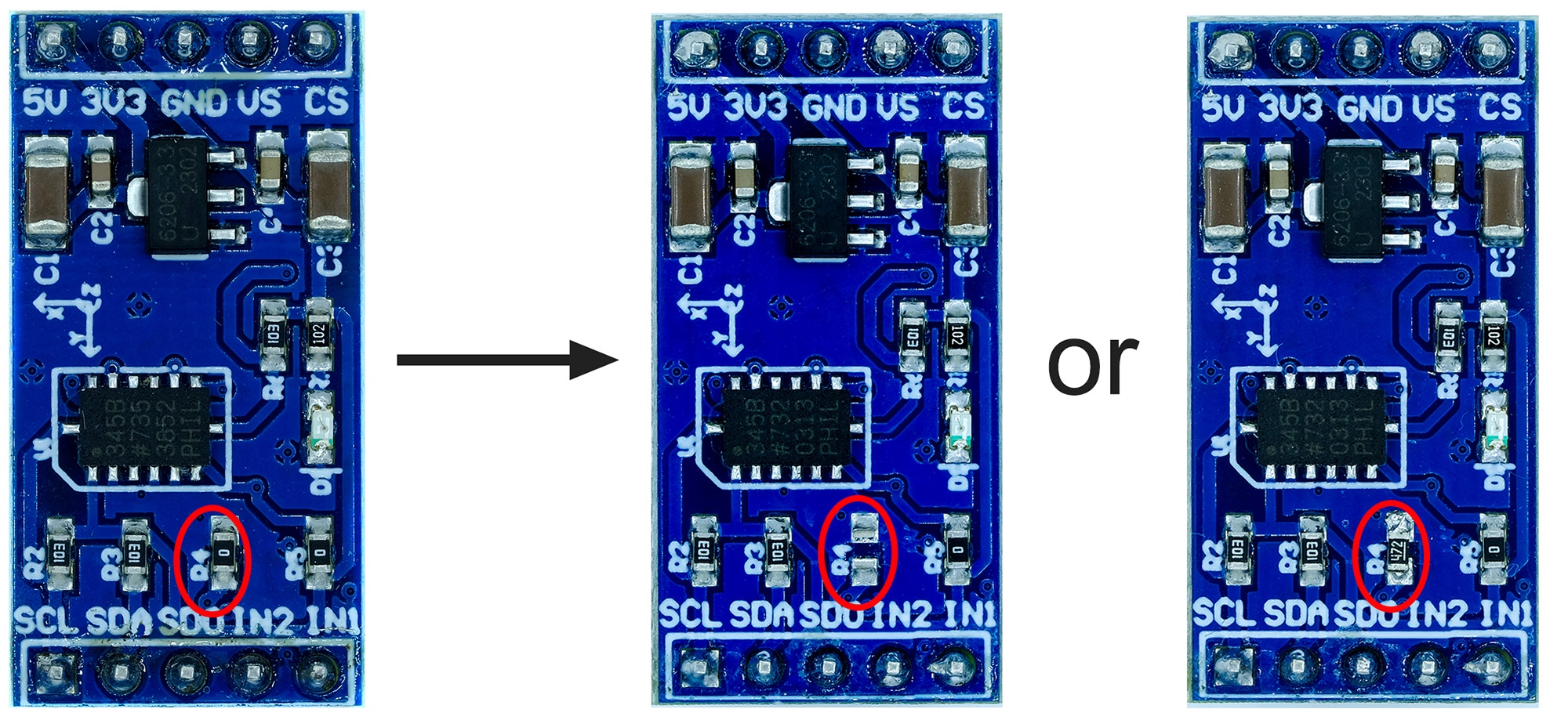
| Configuration | Appearance in photo | Meaning | Practical effect | Recommendation |
|---|---|---|---|---|
| Left | R4 is mounted and marked with "0" | The 0-ohm resistor acts as a jumper and directly connects the SDO line in the module's default configuration | The module remains in the standard hardware configuration, usually used for I2C or situations where 4-wire SPI is not properly set up | Keep for normal I2C use |
| Middle | R4 is completely removed | The fixed connection on SDO is eliminated | Allows switching to SPI without the factory-imposed hardware strap | Simple and quick solution to activate SPI |
| Right | R4 is replaced with a resistor marked "472" | The 4.7 kohm resistor creates a pull-down on the SDO line instead of a direct connection | Provides a more correct electrical configuration for SPI | Recommended solution for a more stable SPI adaptation |
- Input Voltage
- 3.3 - 5 V
- Input Voltage Type
- “DC” in Romanian can mean **“de ce”**, which translates to **“why”** in English.
Produs destinat utilizarii in proiecte electronice, automatizari, prototipare, educatie si cercetare.
Produsul trebuie utilizat numai conform specificatiilor tehnice mentionate in descriere si/sau in documentatia produsului.
Avertismente generale de siguranta:
Nu utilizati produsul la tensiuni, curenti sau temperaturi peste valorile specificate.
Montajul si conectarea trebuie realizate de persoane cu cunostinte tehnice minime in domeniul electric/electronic.
Evitati scurtcircuitele, inversarea polaritatii si conectarea gresita a alimentarii.
Nu lasati produsul alimentat nesupravegheat in timpul testelor.
Produsul nu este jucarie si nu este destinat copiilor.
Pentru modulele electronice, se recomanda utilizarea in carcase, panouri sau montaje protejate, dupa caz.
Identificare produs:
Denumirea produsului, codul/SKU-ul si caracteristicile tehnice sunt mentionate in pagina produsului si/sau pe eticheta ambalajului.
Producator / Importator / Distribuitor:
Sigmanortec S.R.L.
Calea Bucuresti nr. 9, Targu Jiu, Gorj, Romania
E-mail: [email protected]
Website: www.sigmanortec.ro
Persoana responsabila in UE:
Sigmanortec S.R.L.
Calea Bucuresti nr. 9, Targu Jiu, Gorj, Romania
E-mail: [email protected]
Documentatie si siguranta:
Pentru informatii suplimentare, fise tehnice, declaratii de conformitate sau instructiuni, ne puteti contacta la [email protected].