
Product images are for informational purposes only and may vary slightly depending on the batch and supplier. Product specifications and prices may be subject to change without notice. We do our best to provide accurate and complete product specifications, but they may not be completely accurate. If you encounter any such situation, please let us know.
The product is intended for specialists and requires qualified and authorized personnel. The product does not include assembly/use instructions . Putting the product into operation by unqualified persons leads to the loss of the warranty according to the Terms and Conditions on the site.
The specified technical parameters (current, power, etc.) represent maximum allowable values under ideal operating conditions. For safe use and optimal lifespan, it is recommended to operate the product continuously at no more than 50% of the specified maximum values.
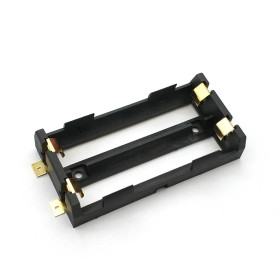
18650 Battery Holder 2S, 2 Cells in Series, 5.5 x 2.1 mm Plug, 7.4V
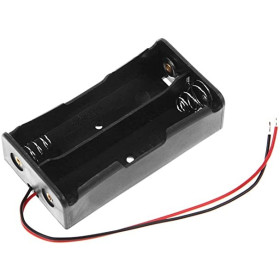
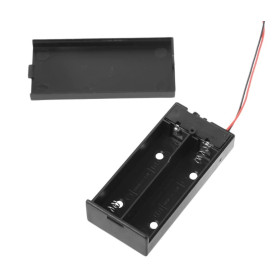
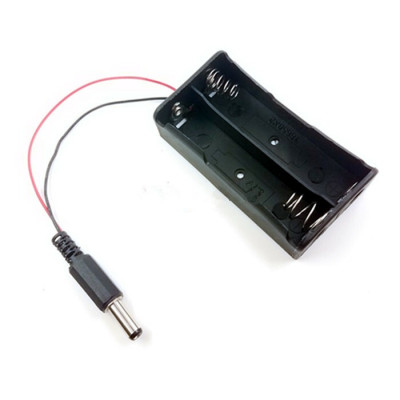
Holder for 2 x 3.7V 18650 batteries, ideal for quickly powering DIY projects, electronic modules or portable devices. It provides secure mounting of the cells in a 2S configuration, has an integrated cable for easy connection, a 5.5 x 2.1 male connector compatible with many devices, and a compact, durable construction for repeated use.
Buying this product earns you 0.30 RON in loyalty points.

International fast shipping within EU. Free Shipping for orders above 100 EUR in most EU countries.

We ship from our stock within 24H

You earn points with every order, worth 5%.
The holder for 2 18650 batteries is a portable power accessory that connects the two Li-Ion batteries in series (2S) and brings them out on a two-wire cable ending in a 5.5 x 2.1 mm male plug. It is suitable for powering consumers with a 5.5 x 2.1 mm DC socket that accepts approximately 7.4 V, in mobile projects, in field test equipment, or as a backup source without mains.
The two slots are connected in series, so the voltages of the batteries add up, while the capacity remains that of a single battery. With two 3.7 V batteries the nominal voltage is 7.4 V, and with fully charged batteries the voltage reaches 8.4 V. The plug has positive on the centre pin and negative on the outer sleeve.
The main features include the black plastic housing with two slots for 18650 batteries, the metal spring contacts at the ends of the slots, the cable with a red wire for positive and a black wire for negative, and a 5.5 x 2.1 mm male plug with strain relief at the base of the cable. The holder has no switch, protection circuit or charger, and it is powered exclusively by the batteries inserted in the slots.
Specifications:
Output voltage: 7.4 V nominal (2 x 3.7 V), 8.4 V with fully charged batteries
Number of batteries: 2
Battery type: Li-Ion 18650
Battery connection: Series (2S)
Connector: 5.5 x 2.1 mm male plug, positive on the centre pin
Cable: Red wire (+) and black wire (-)
Protection and switch: None
Layout:
| Element | Function |
|---|---|
| Slots for 18650 batteries | Two slots for Li-Ion 18650 batteries, connected in series. The + and - markings are reversed from one slot to the other, because the batteries are in series. |
| Spring contacts | The metal contacts at the ends of the slots. The spring presses the negative end of the battery and ensures the electrical contact. |
| Red wire | Positive supply, approximately 7.4 V, connected to the centre pin of the plug. |
| Black wire | Negative supply (GND), connected to the outer sleeve of the plug. |
| 5.5 x 2.1 mm male plug | Supplies power to the female DC socket of the consumer. |
Usage:
Prepare two 18650 batteries of the same type, with the same capacity, the same voltage and the same degree of wear.
Measure the voltage of each battery with a multimeter. Both should be between 3.7 V and 4.2 V, with a difference of at most a few tens of millivolts between them. Do not use a battery below 3.0 V.
Insert the batteries respecting the + and - markings in each slot. Press the negative end onto the spring, then lower the positive end into the slot.
Measure the voltage at the plug, with the multimeter on the DC voltage range, red probe on the centre pin and black probe on the sleeve. You should read between 7.4 V and 8.4 V. If the value has a minus sign, the polarity is reversed and you must not connect the plug to a consumer with positive on the centre pin.
Check that the consumer's socket is 5.5 x 2.1 mm, has positive on the centre pin and accepts 7.4 - 8.4 V. Only then insert the plug fully into the socket.
Do not apply to the holder a load that exceeds the maximum discharge current of the batteries used, and do not short-circuit the wires.
The holder has no switch, so remove the plug from the socket to stop the power supply. Remove the batteries from the holder if you do not use the equipment for a period of time.
Charge the batteries outside the holder, with a charger suitable for Li-Ion, because the holder has no charging or protection circuit.
- Output voltage
- 7.4 V nominal (2 x 3.7 V), 8.4 V with fully charged batteries
- Connector type
- Male plug 5.5 x 2.1 mm, positive on center pin
- Protections
- None
- Configuration
- Series (2S)
- Battery type
- Li-Ion 18650
- Number of cells
- 2
Produs destinat utilizarii in proiecte electronice, automatizari, prototipare, educatie si cercetare.
Produsul trebuie utilizat numai conform specificatiilor tehnice mentionate in descriere si/sau in documentatia produsului.
Avertismente generale de siguranta:
Nu utilizati produsul la tensiuni, curenti sau temperaturi peste valorile specificate.
Montajul si conectarea trebuie realizate de persoane cu cunostinte tehnice minime in domeniul electric/electronic.
Evitati scurtcircuitele, inversarea polaritatii si conectarea gresita a alimentarii.
Nu lasati produsul alimentat nesupravegheat in timpul testelor.
Produsul nu este jucarie si nu este destinat copiilor.
Pentru modulele electronice, se recomanda utilizarea in carcase, panouri sau montaje protejate, dupa caz.
Identificare produs:
Denumirea produsului, codul/SKU-ul si caracteristicile tehnice sunt mentionate in pagina produsului si/sau pe eticheta ambalajului.
Producator / Importator / Distribuitor:
Sigmanortec S.R.L.
Calea Bucuresti nr. 9, Targu Jiu, Gorj, Romania
E-mail: [email protected]
Website: www.sigmanortec.ro
Persoana responsabila in UE:
Sigmanortec S.R.L.
Calea Bucuresti nr. 9, Targu Jiu, Gorj, Romania
E-mail: [email protected]
Documentatie si siguranta:
Pentru informatii suplimentare, fise tehnice, declaratii de conformitate sau instructiuni, ne puteti contacta la [email protected].
Reviews (5) - Review moderation

Produs perfect
Foarte bun! L am folosit in proiectul Smart car.
Corespunzator
Conform asteptarilor
Pentru alimentare osciloscop Hobby.
The holder for 2 18650 batteries with 5.5 x 2.1 plug is a passive power accessory for portable projects. It connects the two batteries in series and brings them out on a cable terminated with a male plug, which goes directly into the DC socket of the consumer. The tutorial covers commissioning, checking the voltage and a power example, without a program.
You can use it with mobile robots, field test equipment and any consumer with a 5.5 x 2.1 DC socket that accepts approximately 7.4 V.

How it works:
The two slots are connected in series, so the voltages of the two batteries add up, while the capacity remains that of a single battery. A 18650 Li-Ion battery has 3.7 V nominal, 4.2 V when fully charged and around 3.0 V when almost discharged. This gives 2 x 3.7 V = 7.4 V nominal, 2 x 4.2 V = 8.4 V with full batteries and 2 x 3.0 V = 6.0 V at the recommended lower limit.
Runtime is estimated with the formula: time (hours) = capacity (mAh) / current drawn (mA). With two 3000 mAh batteries and a 200 mA consumer, the theoretical result is 3000 / 200 = 15 hours. In practice you get less, because the real capacity drops at high currents and when the batteries are worn.
The holder contains only the spring contacts and the cable. It has no protection circuit, switch or charger. Protection against over-discharge, short circuit and overcurrent depends on the batteries used or on a protection module added separately.
Connection:
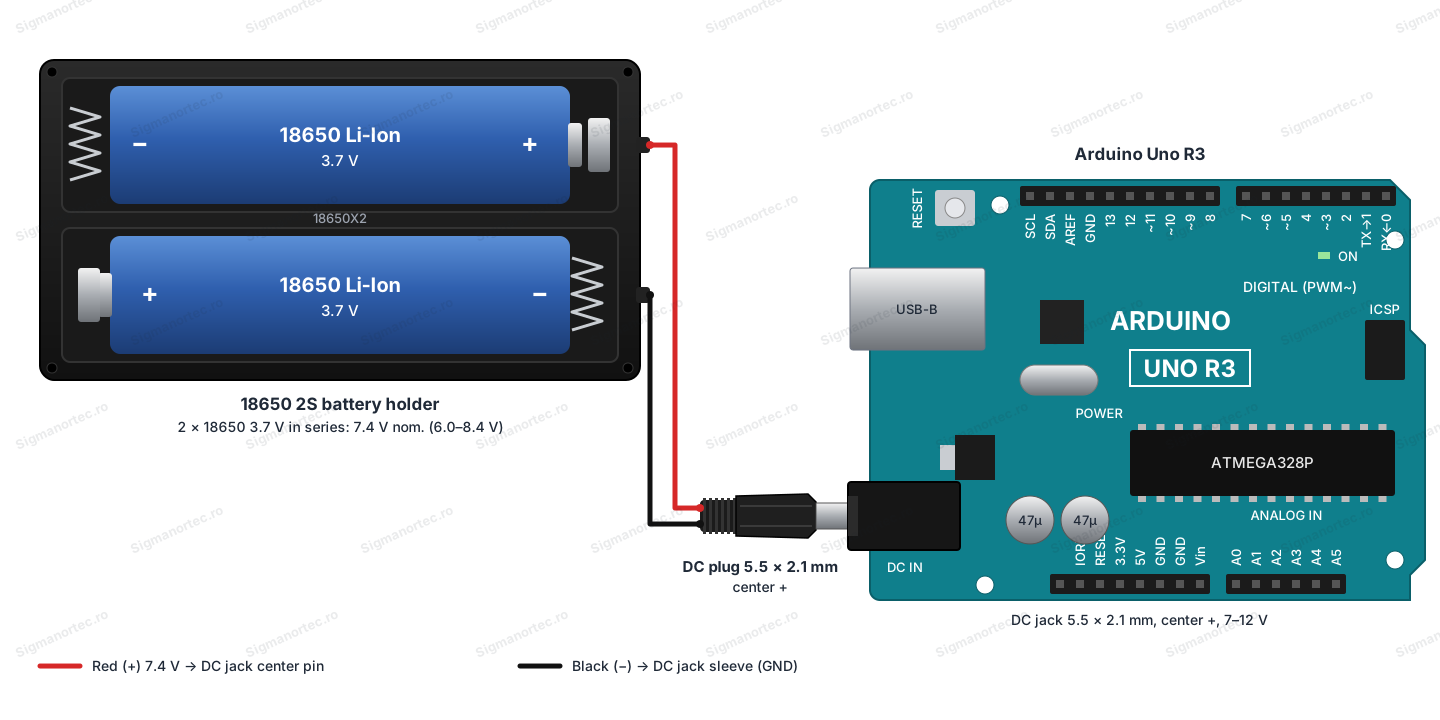
The holder does not connect to board pins. It connects through its plug to a consumer that accepts around 7.4 V and has a female 5.5 x 2.1 DC socket, with plus on the centre pin. In the diagram, the consumer is an Arduino Uno R3 board powered through its DC socket. Check the polarity of the socket before the first connection.
| Product pin | Connect to | Role |
|---|---|---|
| Red wire (+) | Centre pin of the consumer's DC socket (DC_IN+) | Power supply plus, approximately 7.4 V |
| Black wire (-) | Outer sleeve of the DC socket (DC_IN-) | Power supply minus (GND) |
| Male plug 5.5 x 2.1 mm | Female 5.5 x 2.1 DC socket of the consumer | Supplies power to the consumer |
| The two 18650 slots | 2 Li-Ion 18650 batteries of 3.7 V | Series connection of the batteries |
Usage example:
Powering an Arduino Uno R3 board from batteries, without a USB cable. The board's DC socket is 5.5 x 2.1 mm, with plus on the centre pin, and the recommended range for this socket is 7 - 12 V.
Prepare two identical 18650 batteries, with the same capacity and the same charge, with close voltages and each above 3.0 V. Measure them with the multimeter before fitting.
Insert the batteries into the slots respecting the + and - markings and pressing the negative end against the spring. The markings show different directions in the two slots, because the batteries are in series.
Measure the voltage at the plug, with red on the centre pin and black on the sleeve. With full batteries you should read approximately 8.4 V, with plus on the centre pin.
Insert the plug into the board's socket. The ON LED on the board should light up immediately.
As the batteries discharge, the voltage drops below 7 V. The board's regulator no longer receives enough voltage and the 5 V output may drop, which leads to resets. When you notice resets or unstable behavior, remove the plug and charge the batteries outside the holder, with a charger suitable for Li-Ion.
Common problems:
The consumer does not start and the power LED stays off. The most frequent cause is a battery inserted in reverse or a weak spring contact. Check the markings in the slots, then measure the voltage at the plug. If it is missing, remove the batteries and reinsert them, pressing firmly on the springs.
The voltage measured at the plug is about 3.7 V instead of 7.4 V. The cause is a single battery making contact, the other being removed, fully discharged or with a weak contact. Measure each battery separately and replace the one with the much lower voltage.
The consumer resets or shuts down when a motor, a relay or a radio module starts. The cause is the voltage drop of discharged batteries or of batteries with a low maximum current, especially when the consumption rises suddenly. Use fully charged batteries, with a discharge current suitable for the load, and power the motors separately, from their own source.
The plug is loose in the socket and the power cuts out at a slight movement. The cause is a mismatch between the plug size and the socket size or wear of the socket. Check that the socket is 5.5 x 2.1 mm and secure the cable with a loop or a strap, so that it does not pull on the plug.
The batteries or the holder heat up during operation. The cause may be a current too high for the battery limits or a short circuit of the wires. Disconnect the plug immediately, check the cable and the consumer and use batteries with a discharge current suitable for the load.
Limitations and tips:
The holder has no protection against over-discharge, short circuit or overcurrent, has no switch and does not charge the batteries. The output voltage varies between 8.4 V and 6.0 V during discharge, so the consumer must accept this range.
Always use two identical batteries and do not mix new batteries with worn ones. For a consumer sensitive to voltage variation you can add a DC-DC converter, and for additional protection a 2S protection module fitted between the holder and the consumer.