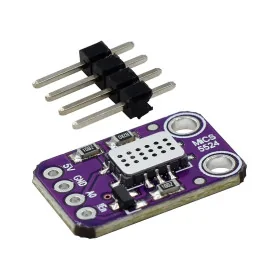

Product images are for informational purposes only and may vary slightly depending on the batch and supplier. Product specifications and prices may be subject to change without notice. We do our best to provide accurate and complete product specifications, but they may not be completely accurate. If you encounter any such situation, please let us know.
The product is intended for specialists and requires qualified and authorized personnel. The product does not include assembly/use instructions . Putting the product into operation by unqualified persons leads to the loss of the warranty according to the Terms and Conditions on the site.
The specified technical parameters (current, power, etc.) represent maximum allowable values under ideal operating conditions. For safe use and optimal lifespan, it is recommended to operate the product continuously at no more than 50% of the specified maximum values.
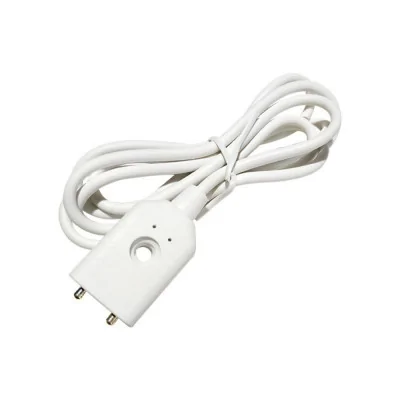
Water Leak Detection Probe, WLS02, Stainless Steel Electrode, 12-24V, NO, 1m Cable
Passive probe for water leak detection, signals the presence of liquid through the conductivity between two electrodes. Stainless steel electrode resistant to corrosion, including in humid environments or saltwater. Compatible with 12-24V systems and NO output through external module, it has a 1 m cable for flexible installation in technical rooms, under equipment, or in basements.
Shipping by Wednesday 16 September

International fast shipping within EU. Free Shipping for orders above 100 EUR in most EU countries.

We ship from our stock within 24H

You earn points with every order, worth 5%.
The stainless steel electrode water leak detection probe is a passive detection element designed to signal the presence of water in areas where there is a risk of accidental infiltration or accumulation.
It does not function like a classic mechanical contact that is open or closed, but based on the conductivity of the water between the two electrodes. When water simultaneously touches both electrodes, a lower resistance appears between them, and a control module, relay, alarm, PLC, or microcontroller can interpret the signal and trigger a warning.
The stainless steel construction helps prevent rust and allows use even in saltwater, while the compact format allows flexible mounting in narrow corners, under equipment, in technical rooms, basements, warehouses, residences, commercial or industrial spaces.
It is suitable for leak detection systems, automation, monitoring applications, and projects with Arduino or other controllers when used together with a compatible detection circuit.
Specifications:
System Power Supply Voltage: 12V - 24V
Product Type: Water leak detection probe
Operation Type: Passive, based on water conductivity
Electrode Material: Stainless steel
Operating Temperature: -10°C to 50°C
Operating Humidity: 20% RH - 100%
System Output Type: NO normally open, depending on the module used
Detection Cable Included: 1 m
Mounting: fixing hole
Usage:
The probe is mounted in an area where there is a risk of water accumulation or leakage so that the two electrodes can come into direct contact with the liquid. When water touches both electrodes, it creates a conductive bridge, and the resulting signal is read by an external alarm module, a relay, a PLC, or a microcontroller such as Arduino.
The product is not a standalone sensor with a built-in relay but must be used together with a compatible detection or monitoring unit. It is recommended for protecting technical spaces, warehouses, basements, areas under heating plants, washing machines, sinks, pipes, or tanks.
Arduino Example:
This probe can be used with Arduino to detect the presence of water by measuring the variation in conductivity between the two electrodes. In contact with water, the resistance between the electrodes decreases, and Arduino can read this change as an analog value.
For testing with Arduino, the probe is not powered at 12-24V but is integrated into a simple circuit powered at 5V so that the voltage read on the analog pin is safe for the board.
| Component | Connection |
|---|---|
| Probe wire 1 | Arduino 5V |
| Probe wire 2 | Arduino A0 |
| 100k resistor | between A0 and GND |
| Arduino GND | common ground |
In this setup, the probe and the 100k resistor form a voltage divider:
- without water: the probe resistance is very high, and the value read on A0 is low.
- with water between electrodes: the probe resistance decreases, and the value on A0 increases.
The exact value depends on the type of water, impurities, distance between electrodes, cable length.
- Output Type Voltage
- Closed-Open Contact
- Input Voltage
- 12 - 24 VDC
- Input Voltage Type
- “DC” in Romanian can mean **“de ce”**, which translates to **“why”** in English.
- Material
- Inox
- Cable length
- 1 m
Produs destinat utilizarii in proiecte electronice, automatizari, prototipare, educatie si cercetare.
Produsul trebuie utilizat numai conform specificatiilor tehnice mentionate in descriere si/sau in documentatia produsului.
Avertismente generale de siguranta:
Nu utilizati produsul la tensiuni, curenti sau temperaturi peste valorile specificate.
Montajul si conectarea trebuie realizate de persoane cu cunostinte tehnice minime in domeniul electric/electronic.
Evitati scurtcircuitele, inversarea polaritatii si conectarea gresita a alimentarii.
Nu lasati produsul alimentat nesupravegheat in timpul testelor.
Produsul nu este jucarie si nu este destinat copiilor.
Pentru modulele electronice, se recomanda utilizarea in carcase, panouri sau montaje protejate, dupa caz.
Identificare produs:
Denumirea produsului, codul/SKU-ul si caracteristicile tehnice sunt mentionate in pagina produsului si/sau pe eticheta ambalajului.
Producator / Importator / Distribuitor:
Sigmanortec S.R.L.
Calea Bucuresti nr. 9, Targu Jiu, Gorj, Romania
E-mail: [email protected]
Website: www.sigmanortec.ro
Persoana responsabila in UE:
Sigmanortec S.R.L.
Calea Bucuresti nr. 9, Targu Jiu, Gorj, Romania
E-mail: [email protected]
Documentatie si siguranta:
Pentru informatii suplimentare, fise tehnice, declaratii de conformitate sau instructiuni, ne puteti contacta la [email protected].
const int sensorPin = A0;
const int ledPin = 13;
int sensorValue = 0;
int threshold = 300;
void setup() {
Serial.begin(9600);
pinMode(ledPin, OUTPUT);
Serial.println("Analog water leak probe test");
}
void loop() {
sensorValue = analogRead(sensorPin);
Serial.print("Sensor value: ");
Serial.println(sensorValue);
if (sensorValue > threshold) {
digitalWrite(ledPin, HIGH);
Serial.println("Water detected");
} else {
digitalWrite(ledPin, LOW);
Serial.println("No water detected");
}
delay(500);
}