
Product images are for informational purposes only and may vary slightly depending on the batch and supplier. Product specifications and prices may be subject to change without notice. We do our best to provide accurate and complete product specifications, but they may not be completely accurate. If you encounter any such situation, please let us know.
The product is intended for specialists and requires qualified and authorized personnel. The product does not include assembly/use instructions . Putting the product into operation by unqualified persons leads to the loss of the warranty according to the Terms and Conditions on the site.
The specified technical parameters (current, power, etc.) represent maximum allowable values under ideal operating conditions. For safe use and optimal lifespan, it is recommended to operate the product continuously at no more than 50% of the specified maximum values.
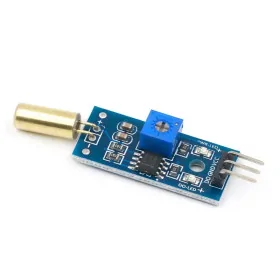
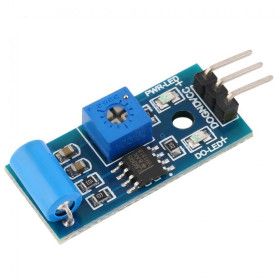
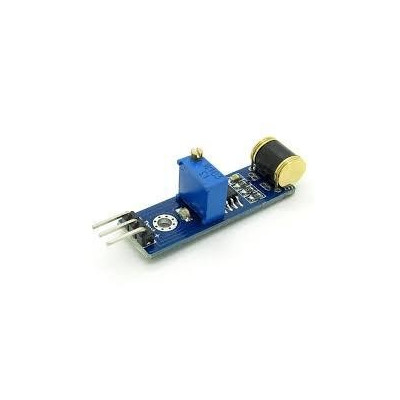
Vibration Sensor 801S, Adjustable, LM393, 3.3–5V
Adjustable vibration sensor for detecting shocks and vibrations in electronic projects and industrial equipment, with a digital output for easy integration into microcontrollers and monitoring systems. Sensitivity is quickly adjusted from the potentiometer, provides stable and repeatable response, operates at common supply voltages, and has a compact form factor for easy mounting on a board.
Shipping by Wednesday 11 November
Buying this product earns you 1.03 RON in loyalty points.

International fast shipping within EU. Free Shipping for orders above 100 EUR in most EU countries.

We ship from our stock within 24H

You earn points with every order, worth 5%.
The 801S vibration sensor module combines a shock sensor with gold-alloy plated contacts and an LM393 comparator, providing a logic signal on the Dout pin that goes HIGH on impacts, shocks, or vibrations. It is suitable for anti-theft alarms, electronic locks, vibration detection on mechanical equipment, counting hits on targets, and motion monitoring projects.
The 801S sensor does not use a mechanical switching element, but a resistive element whose resistance changes with movement, which is why it also reacts to a light touch and works in any orientation. The rated lifespan is 60,000,000 shocks. The LM393 comparator converts the sensor signal into a logic level, and the sensitivity threshold is adjusted with the trimmer on the board. The output is normally LOW and generates a series of HIGH pulses when a shock occurs, and it may take up to 2 seconds to return stably to LOW after the vibration stops.
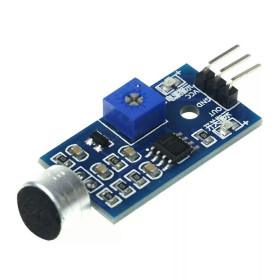
Among the main features are the gold-plated 801S sensor, the LM393 comparator, the blue sensitivity adjustment trimmer, the indicator LED, the mounting hole, and the 3-pin header marked with the symbols - , Dout and +. Power is supplied at 3.3 - 5 VDC directly from the development board.
Thanks to the 3.3 V and 5 V compatible logic output, the module connects directly to Arduino, ESP32, STM32, Raspberry Pi, and other platforms that have a free digital input.
Specifications:
Supply voltage: 3.3 - 5 VDC
Current consumption: 2 - 10 mA at 5 V, mostly through the LED
Sensor: 801S, gold-alloy plated
Comparator: LM393
Output: Dout, normally LOW, HIGH pulses on shock or vibration
Logic levels: compatible with 3.3 V and 5 V
Sensitivity adjustment: 103 trimmer (10 kOhm)
Sensor lifespan: 60,000,000 shocks
Mounting orientation: any
Return-to-LOW time: up to 2 s
Indicator: activity LED
Mounting: fixing hole
Dimensions: 35 x 11.5 mm
Layout:
| Element | Function |
|---|---|
| 801S shock sensor | Detects shocks and vibrations by varying the resistance of the sensitive element, in any orientation. |
| 103 trimmer (10 kOhm) | Adjusts the sensitivity threshold of the LM393 comparator. Turning it counterclockwise increases sensitivity, and turning it clockwise decreases it. |
| LM393 comparator | Compares the sensor signal with the threshold set by the trimmer and provides the logic level on the Dout pin. |
| Indicator LED | It is lit at rest. It briefly turns off or appears to flicker when a shock or vibration is detected. |
| 3-pin header | The module connector, marked - (GND), Dout (output), and + (power). |
| Mounting hole | Fixing the module with a screw. |
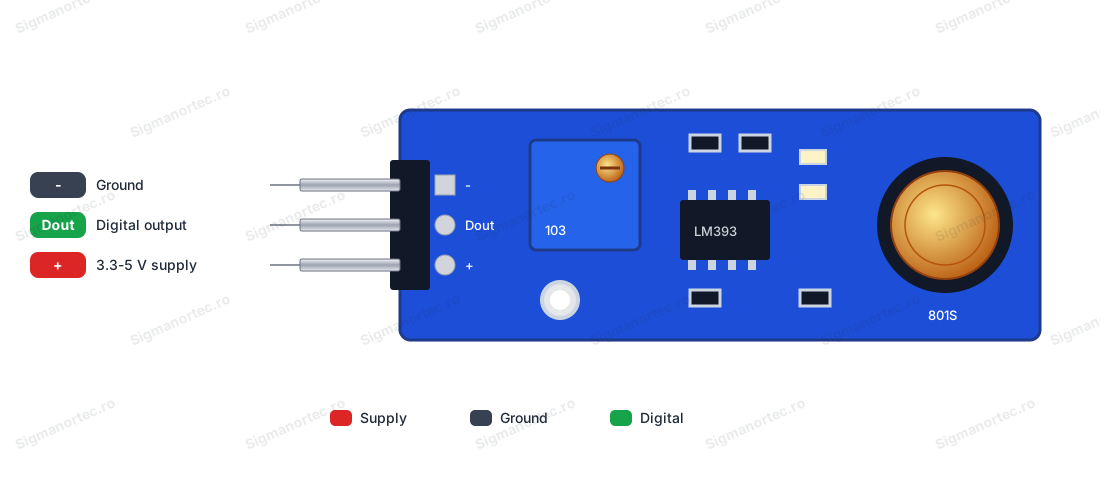
Pinout:
| Connector | Pin | Function |
|---|---|---|
| 3-pin header | - | GND, ground |
| 3-pin header | Dout | Signal output, normally LOW, HIGH pulses on shock or vibration |
| 3-pin header | + | 3.3 - 5 VDC power supply |
Usage:
Connect the - pin to GND, the + pin to 3.3 V or 5 V, and the Dout pin to a digital input of the development board, respecting the power polarity.
Power the module and check the LED, which should be lit at rest.
Initial adjustment is done with the trimmer approximately at mid-travel. Lightly tap the surface on which the module is mounted and observe the LED, which turns off or flickers, and the Dout output, which generates HIGH pulses.
For higher sensitivity, turn the trimmer counterclockwise; if the module reacts to unwanted vibrations, turn it clockwise until the LED responds only to the desired shocks.
In the program, treat the signal like a mechanical contact. After the first LOW-to-HIGH edge, ignore new edges for 50 - 200 ms, because a single shock may generate multiple pulses at the output.
Do not apply voltages higher than the allowed ones to the module, and do not reverse the power supply.
For stable results, firmly attach the module to the monitored surface, as loose mounting may cause false triggers.
- Supply voltage
- 3.3-5 V DC
- Dimensions
- 35 x 11.5 mm
- Output type
- Dout, normally LOW, HIGH pulses on shock or vibration
- Power consumption
- 2-10 mA at 5 V
- Integrated circuit
- LM393
- Sensor
- 801S, gold alloy plated
- Service life
- 60,000,000 shocks
Produs destinat utilizarii in proiecte electronice, automatizari, prototipare, educatie si cercetare.
Produsul trebuie utilizat numai conform specificatiilor tehnice mentionate in descriere si/sau in documentatia produsului.
Avertismente generale de siguranta:
Nu utilizati produsul la tensiuni, curenti sau temperaturi peste valorile specificate.
Montajul si conectarea trebuie realizate de persoane cu cunostinte tehnice minime in domeniul electric/electronic.
Evitati scurtcircuitele, inversarea polaritatii si conectarea gresita a alimentarii.
Nu lasati produsul alimentat nesupravegheat in timpul testelor.
Produsul nu este jucarie si nu este destinat copiilor.
Pentru modulele electronice, se recomanda utilizarea in carcase, panouri sau montaje protejate, dupa caz.
Identificare produs:
Denumirea produsului, codul/SKU-ul si caracteristicile tehnice sunt mentionate in pagina produsului si/sau pe eticheta ambalajului.
Producator / Importator / Distribuitor:
Sigmanortec S.R.L.
Calea Bucuresti nr. 9, Targu Jiu, Gorj, Romania
E-mail: [email protected]
Website: www.sigmanortec.ro
Persoana responsabila in UE:
Sigmanortec S.R.L.
Calea Bucuresti nr. 9, Targu Jiu, Gorj, Romania
E-mail: [email protected]
Documentatie si siguranta:
Pentru informatii suplimentare, fise tehnice, declaratii de conformitate sau instructiuni, ne puteti contacta la [email protected].
/*
  Board: Arduino Uno (Tools > Board > Arduino AVR Boards > Arduino Uno)
  Libraries: none needed.

  Wiring:
    Sensor +    -> Arduino 5V
    Sensor -    -> Arduino GND
    Sensor Dout -> Arduino D2
*/

const uint8_t SENSOR_PIN = 2;              // Dout of the 801S module
const unsigned long LOCKOUT_MS = 200;      // Debounce time after a detected shock

unsigned long lastShock = 0;               // Time of the last detected shock
unsigned long shockCount = 0;              // Total number of shocks
int lastState = LOW;                       // Previous state of Dout

void setup() {
  Serial.begin(9600);                      // Serial monitor at 9600 baud
  pinMode(SENSOR_PIN, INPUT);              // Dout is driven by the module
  Serial.println("801S vibration sensor test");
}

void loop() {
  int state = digitalRead(SENSOR_PIN);     // Read the sensor output

  // Detect a LOW to HIGH transition
  if (state == HIGH && lastState == LOW) {
    unsigned long now = millis();
    if (now - lastShock >= LOCKOUT_MS) {   // Ignore repeated pulses of the same shock
      lastShock = now;
      shockCount++;
      Serial.print("Vibration detected, count: ");
      Serial.println(shockCount);
    }
  }
  lastState = state;                       // Remember the state for the next loop
}