

Product images are for informational purposes only and may vary slightly depending on the batch and supplier. Product specifications and prices may be subject to change without notice. We do our best to provide accurate and complete product specifications, but they may not be completely accurate. If you encounter any such situation, please let us know.
The product is intended for specialists and requires qualified and authorized personnel. The product does not include assembly/use instructions . Putting the product into operation by unqualified persons leads to the loss of the warranty according to the Terms and Conditions on the site.
The specified technical parameters (current, power, etc.) represent maximum allowable values under ideal operating conditions. For safe use and optimal lifespan, it is recommended to operate the product continuously at no more than 50% of the specified maximum values.
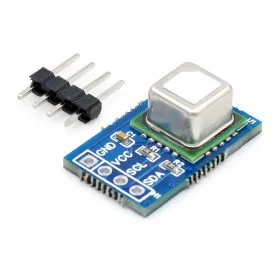
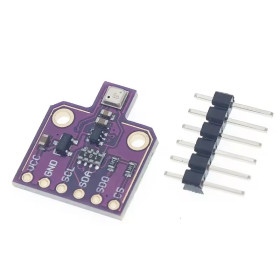
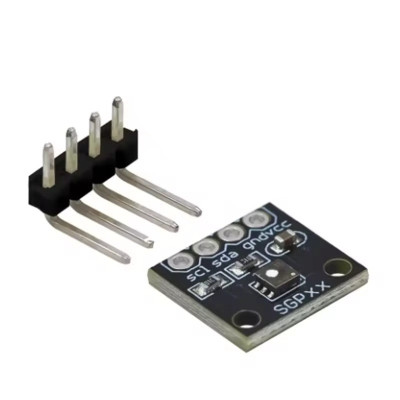
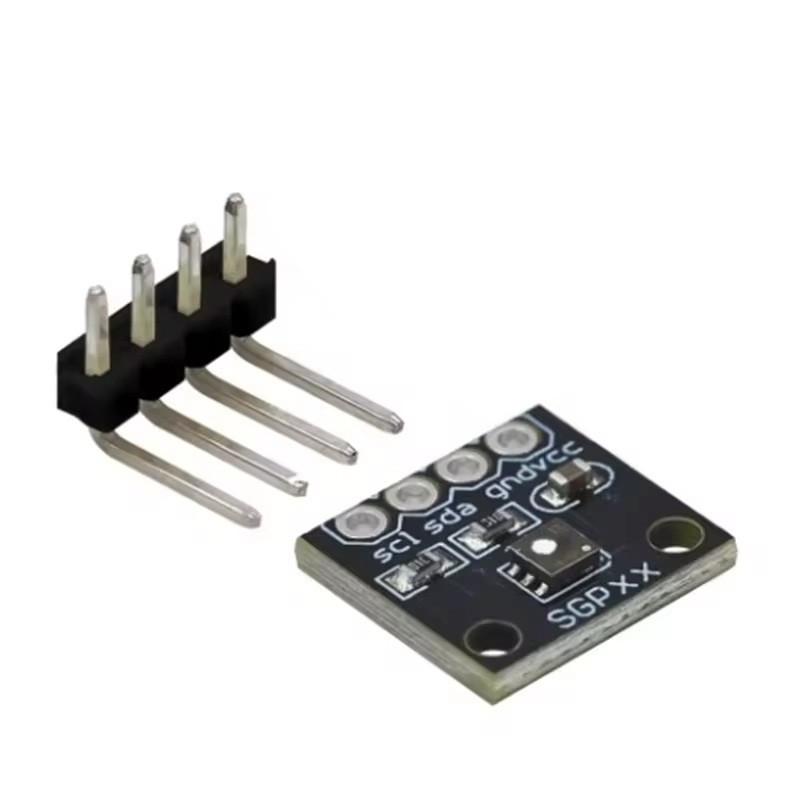
SGP41 air quality sensor module, VOC and NOx, I2C, 3.3V
Compact module for real-time air quality monitoring, detects VOC and NOx with Sensirion MOX technology, I2C communication for quick integration with Arduino, ESP32, Raspberry Pi or STM32, operates at low 3.3V voltage ideal for battery-powered devices, suitable for smart home, HVAC, purifiers and portable weather stations.
Shipping by Thursday 22 October
Buying this product earns you 0.66 € in loyalty points.

International fast shipping within EU. Free Shipping for orders above 100 EUR in most EU countries.

We ship from our stock within 24H

You earn points with every order, worth 5%.
Module based on the SGP41 sensor, designed for measuring air quality, compatible with Arduino and other development boards, used in smart home applications, HVAC, air purifiers or portable weather stations.
The sensor uses Sensirion's integrated MOX (metal oxide) technology to detect VOC (volatile organic compounds) and NOx (nitrogen oxide) gases, providing an accurate assessment of air quality in real time.
The module is mounted on a black board with a standard I2C interface, making it easy to integrate onto boards such as Arduino, ESP32, Raspberry Pi or STM32. It operates at low voltages between 1.62V and 1.98V, making it suitable for portable applications and battery-powered devices.
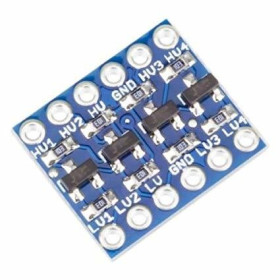
Attention! The sensor is not compatible with logic levels and power supply higher than 1.9VDC! Use a logic level converter and power supply of 1.8VDC!
Specifications:
Supply voltage: 1.62 – 1.98 VDC
Sensor type: SGP41 (Sensirion)
Measured parameters: VOC and NOx
Interface: I2C (standard address 0x59)
Typical current: < 2 mA in active mode
Warm-up time: < 10 s
Module size: 10 × 10 mm
Board material: FR4, black PCB
Pinout:
| Pine | Name | Function | Description |
|---|---|---|---|
| 1 | VCC | feeding | 1.62V – 1.98V |
| 2 | GND | Mass | Common reference |
| 3 | SDA | I²C data | Bidirectional data line |
| 4 | SCL | I²C clock | Communication synchronization |
Use:
Connect the sensor to the microcontroller via the I2C bus:
VCC → 1.8 V
GND → GND common
SDA → I²C SDA pin
SCL → I²C SCL pin
Initializes communication at address 0x59.
Start the heating and VOC/NOx reading routine according to the Sensirion library (available for Arduino and Raspberry Pi).
Interpret the returned values:
VOC Index (0–500)
NOx Index (0–500)
Low values indicate clean air. High values indicate polluted air.
Attention! The sensor is not compatible with logic levels and power supply higher than 1.9VDC! Use a logic level converter and power supply of 1.8VDC!
Example of connection with Arduino and logic level converter:
| Arduino UNO | Level conversion mode | SGP41 |
|---|---|---|
| 5V | HV | – |
| GND | GND | GND |
| SDA (A4) | HV1 → LV1 | SDA |
| SCL (A5) | HV2 → LV2 | SCL |
| LV (low side) | – | 1.8V |
| HV (high side) | – | 5V |
| 1.8V LDO OUT | – | VCC |
- Input Voltage
- 1.6 V
- Input Voltage Type
- “DC” in Romanian can mean **“de ce”**, which translates to **“why”** in English.
Produs destinat utilizarii in proiecte electronice, automatizari, prototipare, educatie si cercetare.
Produsul trebuie utilizat numai conform specificatiilor tehnice mentionate in descriere si/sau in documentatia produsului.
Avertismente generale de siguranta:
Nu utilizati produsul la tensiuni, curenti sau temperaturi peste valorile specificate.
Montajul si conectarea trebuie realizate de persoane cu cunostinte tehnice minime in domeniul electric/electronic.
Evitati scurtcircuitele, inversarea polaritatii si conectarea gresita a alimentarii.
Nu lasati produsul alimentat nesupravegheat in timpul testelor.
Produsul nu este jucarie si nu este destinat copiilor.
Pentru modulele electronice, se recomanda utilizarea in carcase, panouri sau montaje protejate, dupa caz.
Identificare produs:
Denumirea produsului, codul/SKU-ul si caracteristicile tehnice sunt mentionate in pagina produsului si/sau pe eticheta ambalajului.
Producator / Importator / Distribuitor:
Sigmanortec S.R.L.
Calea Bucuresti nr. 9, Targu Jiu, Gorj, Romania
E-mail: [email protected]
Website: www.sigmanortec.ro
Persoana responsabila in UE:
Sigmanortec S.R.L.
Calea Bucuresti nr. 9, Targu Jiu, Gorj, Romania
E-mail: [email protected]
Documentatie si siguranta:
Pentru informatii suplimentare, fise tehnice, declaratii de conformitate sau instructiuni, ne puteti contacta la [email protected].
/*
  Test code for SGP41 VOC and NOx Air Quality Sensor Module
  Board: ESP32 Dev Module
  Wiring:
    SGP41 VCC -> ESP32 3V3
    SGP41 GND -> ESP32 GND
    SGP41 SDA -> ESP32 GPIO21
    SGP41 SCL -> ESP32 GPIO22
  Libraries to install from Library Manager:
    Sensirion I2C SGP41 (Sensirion)
    Sensirion Gas Index Algorithm (Sensirion)
  Note: on a 5V board such as Arduino UNO, power the module from the 3.3V pin
  and use a bidirectional I2C logic level converter on SDA and SCL.
*/

#include <Wire.h>
#include <SensirionI2CSgp41.h>
#include <VOCGasIndexAlgorithm.h>
#include <NOxGasIndexAlgorithm.h>

// I2C pins used on the ESP32 dev board
#define I2C_SDA_PIN 21
#define I2C_SCL_PIN 22

// Default humidity and temperature values used when no external RH/T sensor is connected
// 0x8000 corresponds to 50% RH, 0x6666 corresponds to 25 degC
const uint16_t defaultRh = 0x8000;
const uint16_t defaultT = 0x6666;

SensirionI2CSgp41 sgp41;
VOCGasIndexAlgorithm vocAlgorithm;
NOxGasIndexAlgorithm noxAlgorithm;

uint16_t error;

void setup() {
  Serial.begin(115200);
  delay(1000);

  Wire.begin(I2C_SDA_PIN, I2C_SCL_PIN);
  sgp41.begin(Wire);

  // Read and print the sensor serial number, to confirm the I2C link works
  uint16_t serialNumber[3];
  uint8_t serialNumberSize = 3;
  error = sgp41.getSerialNumber(serialNumber, serialNumberSize);
  if (error) {
    Serial.print("Error getting serial number: ");
    Serial.println(error);
  } else {
    Serial.print("SGP41 serial number: ");
    for (int i = 0; i < serialNumberSize; i++) {
      Serial.print(serialNumber[i], HEX);
      Serial.print(" ");
    }
    Serial.println();
  }

  Serial.println("Conditioning for 10 seconds, do not skip this step.");
  uint16_t srawVoc = 0;
  for (int i = 0; i < 10; i++) {
    error = sgp41.executeConditioning(defaultRh, defaultT, srawVoc);
    if (error) {
      Serial.print("Error during conditioning: ");
      Serial.println(error);
    }
    delay(1000);
  }

  Serial.println("Conditioning done, starting measurements.");
}

void loop() {
  uint16_t srawVoc = 0;
  uint16_t srawNox = 0;

  error = sgp41.measureRawSignals(defaultRh, defaultT, srawVoc, srawNox);

  if (error) {
    Serial.print("Error reading raw signals: ");
    Serial.println(error);
  } else {
    int32_t vocIndex = vocAlgorithm.process(srawVoc);
    int32_t noxIndex = noxAlgorithm.process(srawNox);

    Serial.print("SRAW_VOC: ");
    Serial.print(srawVoc);
    Serial.print("  SRAW_NOX: ");
    Serial.print(srawNox);
    Serial.print("  VOC Index: ");
    Serial.print(vocIndex);
    Serial.print("  NOx Index: ");
    Serial.println(noxIndex);
  }

  delay(1000);
}
The SGP41 sensor module from Sensirion monitors indoor air quality through two distinct signals, one for volatile organic compounds (VOC) and one for nitrogen oxides (NOx). In this tutorial we set up the module with an ESP32 board, since the sensor's I2C interface works natively at 3.3 V, the same logic voltage used by the ESP32, without needing a level converter.
How it works:
The SGP41 sensor has two MOX sensing elements, each with its own micro-heater plate. Each element produces a 16-bit raw signal, SRAW_VOC and SRAW_NOX, proportional to the logarithm of the gas-sensitive layer's resistance. These raw signals aren't directly useful, which is why they're passed through the Sensirion Gas Index Algorithm, running on the microcontroller, which converts them into a VOC Index and a NOx Index on a scale from 1 to 500.
Before the first measurement after each power-up, the sensor needs to be conditioned for 10 s, a period during which the NOx element's hotplate is brought up to its working temperature. After conditioning, the raw signals are read once per second and each value is run through the Gas Index Algorithm, which compares the new reading with the average of the last hours of operation and calculates the corresponding index. A VOC Index of 100 means the air is on average the same as over the last 24 h, while a NOx Index of 1 means there are no oxidizing gases present.
What you need:
- 1 x SGP41 air quality sensor module, VOC and NOx, I2C, 1.6V
- 1 x ESP32-DevKitC development board, ESP32-WROOM-32D, 38P
- 1 x 830 point MB-102 Breadboard
- 4 x 40 Dupont wires 20cm, Male-Male
Wiring:
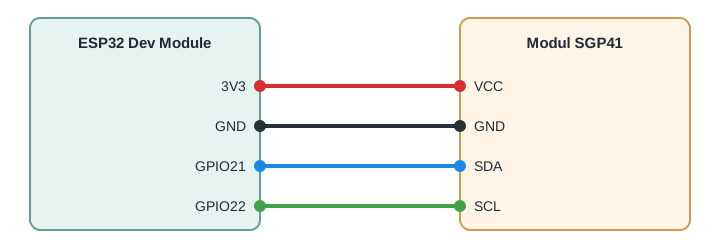
The module is powered at 3.3 V, the same voltage as the ESP32's I2C interface, so the connection is made directly, without a logic level converter. If you're testing the sensor with an Arduino UNO board, power the module from the board's 3.3V pin and route the SDA and SCL lines through a bidirectional logic level converter, since the UNO's I2C pins work at 5 V.
| Product pin | Connects to | Role |
|---|---|---|
| VCC | 3V3 | Sensor power supply |
| GND | GND | Common ground |
| SDA | GPIO21 | I2C data |
| SCL | GPIO22 | I2C clock |
Libraries:
Sensirion I2C SGP41, by Sensirion, for communication with the sensor.
Sensirion Gas Index Algorithm, by Sensirion, for calculating the VOC Index and NOx Index from the raw signals.
Wire, the standard library for I2C communication, included with the ESP32 board package.
The code:
The program conditions the sensor at startup, then reads the raw signals every second and displays them along with the VOC Index and NOx Index.
/*
  SGP41 VOC and NOx Air Quality Sensor with ESP32
  Board: ESP32 Dev Module
  Wiring:
    SGP41 VCC -> ESP32 3V3
    SGP41 GND -> ESP32 GND
    SGP41 SDA -> ESP32 GPIO21
    SGP41 SCL -> ESP32 GPIO22
  Libraries to install from Library Manager:
    Sensirion I2C SGP41 (Sensirion)
    Sensirion Gas Index Algorithm (Sensirion)
*/
#include <Wire.h>
#include <SensirionI2CSgp41.h>
#include <VOCGasIndexAlgorithm.h>
#include <NOxGasIndexAlgorithm.h>
// I2C pins used on the ESP32 dev board
#define I2C_SDA_PIN 21
#define I2C_SCL_PIN 22
// Default humidity and temperature values used when no external RH/T sensor is connected
// 0x8000 corresponds to 50% RH, 0x6666 corresponds to 25 degC, as defined by Sensirion
const uint16_t defaultRh = 0x8000;
const uint16_t defaultT = 0x6666;
SensirionI2CSgp41 sgp41;
VOCGasIndexAlgorithm vocAlgorithm;
NOxGasIndexAlgorithm noxAlgorithm;
uint16_t error;
char errorMessage[256];
void setup() {
  Serial.begin(115200);
  delay(1000);
  // Start I2C bus on the chosen SDA and SCL pins
  Wire.begin(I2C_SDA_PIN, I2C_SCL_PIN);
  sgp41.begin(Wire);
  Serial.println("SGP41 conditioning, please wait 10 seconds...");
  // Conditioning must run for 10 s before the first raw signal measurement
  uint16_t srawVoc = 0;
  for (int i = 0; i < 10; i++) {
    error = sgp41.executeConditioning(defaultRh, defaultT, srawVoc);
    if (error) {
      Serial.print("Error during conditioning: ");
      Serial.println(error);
    }
    delay(1000);
  }
  Serial.println("Conditioning done, starting measurements.");
}
void loop() {
  uint16_t srawVoc = 0;
  uint16_t srawNox = 0;
  // Read raw VOC and NOx signals once per second
  error = sgp41.measureRawSignals(defaultRh, defaultT, srawVoc, srawNox);
  if (error) {
    Serial.print("Error reading raw signals: ");
    Serial.println(error);
  } else {
    // Convert raw signals into VOC Index and NOx Index using the Gas Index Algorithm
    int32_t vocIndex = vocAlgorithm.process(srawVoc);
    int32_t noxIndex = noxAlgorithm.process(srawNox);
    Serial.print("SRAW_VOC: ");
    Serial.print(srawVoc);
    Serial.print("  SRAW_NOX: ");
    Serial.print(srawNox);
    Serial.print("  VOC Index: ");
    Serial.print(vocIndex);
    Serial.print("  NOx Index: ");
    Serial.println(noxIndex);
  }
  delay(1000);
}
How the code works:
In the definitions section, the sgp41 object is created from the SensirionI2CSgp41 class, for communication with the sensor, along with the vocAlgorithm and noxAlgorithm objects from the VOCGasIndexAlgorithm and NOxGasIndexAlgorithm libraries, which take the raw signals in turn and return the indices. The defaultRh and defaultT constants hold the default humidity and temperature values used when no external humidity sensor is available.
In setup, the serial port is initialized, the I2C bus is started with Wire.begin on pins GPIO21 and GPIO22, sgp41.begin is called to bind the object to the bus, then a loop runs calling executeConditioning for 10 iterations, one per second, as required by the sensor before the first measurement.
In loop, measureRawSignals is called once per second, using a delay of 1000 ms, srawVoc and srawNox are retrieved, and each algorithm's process function converts the raw signal into the corresponding index. The results are displayed on the serial monitor with Serial.print, along with the raw signals, for verification.
Result:
Open the serial monitor at 115200 baud. After the 10 s conditioning period, a line appears on screen every second with the raw signals and the VOC Index and NOx Index, the latter needing a few hours of continuous operation to reach fully stable values.
SGP41 conditioning, please wait 10 seconds...
Conditioning done, starting measurements.
SRAW_VOC: 24981  SRAW_NOX: 15234  VOC Index: 100  NOx Index: 1
SRAW_VOC: 24975  SRAW_NOX: 15231  VOC Index: 99  NOx Index: 1
SRAW_VOC: 24988  SRAW_NOX: 15229  VOC Index: 101  NOx Index: 1
SRAW_VOC: 25102  SRAW_NOX: 15240  VOC Index: 108  NOx Index: 1
SRAW_VOC: 25310  SRAW_NOX: 15255  VOC Index: 124  NOx Index: 1
SRAW_VOC: 25006  SRAW_NOX: 15233  VOC Index: 102  NOx Index: 1
Common issues:
The serial monitor shows nothing: check that the serial speed is set to 115200 baud in Serial.begin and in the serial monitor, and check that you've selected the correct ESP32 board in the Arduino IDE.
The sensor doesn't respond at address 0x59: check the SDA and SCL wires, don't swap them, and check that the module is powered at 3.3 V, not 5 V.
VOC Index or NOx Index stay stuck at the same value for a long time: make sure you're calling measureRawSignals every second without interruption, since the Gas Index Algorithm needs a continuous stream of readings to adapt.
NOx Index shows high values that don't go down: let the sensor run continuously for a few hours, since the NOx Index takes longer to fully stabilize after startup than the VOC Index.
Values seem off compared to the real environment: enable humidity compensation by sending actual temperature and humidity values from an external sensor into measureRawSignals, instead of the default values.
Limitations and tips:
The SGP41 module provides a relative estimate of air quality, not an exact concentration of substances, and shouldn't be used as a safety detector for toxic or combustible gases. For stable results, keep the sensor running continuously, without repeated power cycling, and avoid mounting it near direct heat sources or strong air currents. For better accuracy, add an external temperature and humidity sensor, such as the SHT40, whose readings can be fed into the SGP41 for compensation. Based on this setup, you can build a controlled ventilation system that automatically turns on a fan or air purifier when the VOC Index or NOx Index exceeds a set threshold.