

Product images are for informational purposes only and may vary slightly depending on the batch and supplier. Product specifications and prices may be subject to change without notice. We do our best to provide accurate and complete product specifications, but they may not be completely accurate. If you encounter any such situation, please let us know.
The product is intended for specialists and requires qualified and authorized personnel. The product does not include assembly/use instructions . Putting the product into operation by unqualified persons leads to the loss of the warranty according to the Terms and Conditions on the site.
The specified technical parameters (current, power, etc.) represent maximum allowable values under ideal operating conditions. For safe use and optimal lifespan, it is recommended to operate the product continuously at no more than 50% of the specified maximum values.
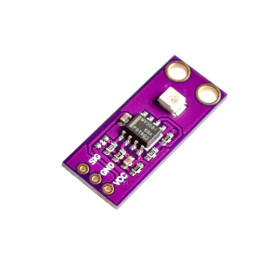
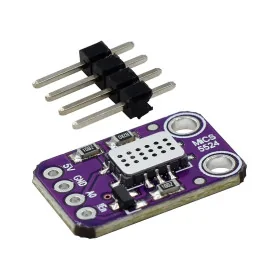
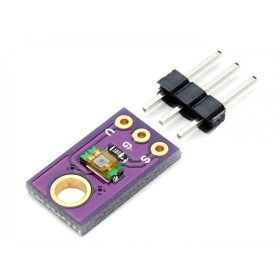
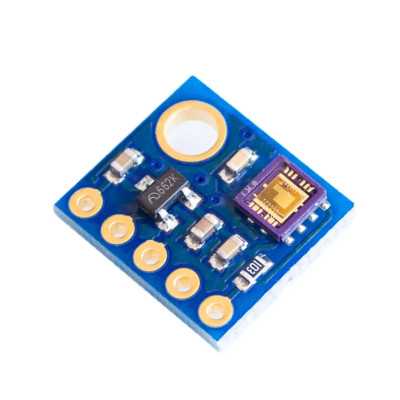
UVA and UVB sensor module, GY-8511, Analog, 3.3V
The ML8511 sensor module accurately measures UVA and UVB radiation intensity for educational projects, laboratory or solar monitoring, operates at 3.3V and provides easy-to-read linear analog output with Arduino, ESP32 or Raspberry Pi, covers 280–390 nm and SOI CMOS integration ensures stable signal with low noise in a compact form factor.
Shipping by Thursday 22 October
Buying this product earns you 1.28 € in loyalty points.

International fast shipping within EU. Free Shipping for orders above 100 EUR in most EU countries.

We ship from our stock within 24H

You earn points with every order, worth 5%.
The GY-8511 module with ML8511 sensor, compatible with Arduino and other development boards, is designed for precise measurement of ultraviolet rays intensity in the UVA and UVB spectrum, making it ideal for educational projects, laboratory experiments, and applications for monitoring exposure to solar radiation. It operates at a voltage of 3.3V and provides a linear analog output proportional to the intensity of UV light, expressed in mW/cm².
The sensor detects ultraviolet radiation in the range of 280–390 nm, covering both the UVB area, responsible for sunburns, and a large part of the UVA area, associated with the tanning process.
Thanks to the SOI CMOS technology developed by OKI, the GY-8511 module integrates both the UV detection element and the operational amplifier in the same chip, eliminating the need for additional external circuits. This architecture ensures a stable output voltage, increased measurement accuracy, and a low noise level in the signal.
The compact design, measuring only 13 x 11 mm, allows easy integration into any type of project, and its weight of only 5 grams makes it suitable for portable applications or mounting on drones, weather stations, or laboratory devices.
The module can be easily connected to boards such as Arduino, ESP32, or Raspberry Pi, being fully compatible with most analog-to-digital conversions used on these platforms.
Specifications:
Detection: UVA and UVB rays (280–390 nm)
Supply voltage: 3.3V
Output voltage: Proportional to UV intensity (mW/cm²)
Weight: 5 g
Technology: SOI CMOS OKI
Output type: Analog
Dimensions: 13 x 11 mm
Pinout:
| Pin | Description |
|---|---|
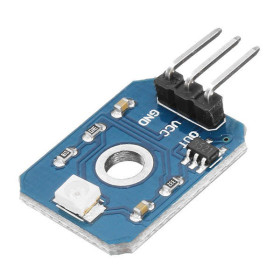
| 3.3V | Power supply at 3.3V |
| GND | Ground |
| OUT | Analog output connected to A0 |
| EN | Enable pin connected to 3.3V |
| Optional 3.3V reference | Can be connected to A1 for reference measurement |
Usage:
Power the module at 3.3V (DO NOT use 5V).
Connect the OUT pin to an analog input (e.g., A0).
Optionally, connect the 3.3V reference to A1 for more accurate measurements.
Use the example code to read analog values and calculate UV intensity.
Position the sensor at a direct angle towards the UV source, without obstacles or reflections.
Allow the sensor to thermally stabilize for about 1 minute before reading.
For outdoor applications, protect the module against moisture and dust.
Calibrate the results by comparison with a standard instrument if necessary.
Usage tips:
Avoid artificial light sources with variable UV spectrum.
Mount the sensor in areas directly exposed to sunlight.
Use averaging of multiple readings to reduce measurement noise.
- Input Voltage
- 3.3 V
- Input Voltage Type
- “DC” in Romanian can mean **“de ce”**, which translates to **“why”** in English.
Produs destinat utilizarii in proiecte electronice, automatizari, prototipare, educatie si cercetare.
Produsul trebuie utilizat numai conform specificatiilor tehnice mentionate in descriere si/sau in documentatia produsului.
Avertismente generale de siguranta:
Nu utilizati produsul la tensiuni, curenti sau temperaturi peste valorile specificate.
Montajul si conectarea trebuie realizate de persoane cu cunostinte tehnice minime in domeniul electric/electronic.
Evitati scurtcircuitele, inversarea polaritatii si conectarea gresita a alimentarii.
Nu lasati produsul alimentat nesupravegheat in timpul testelor.
Produsul nu este jucarie si nu este destinat copiilor.
Pentru modulele electronice, se recomanda utilizarea in carcase, panouri sau montaje protejate, dupa caz.
Identificare produs:
Denumirea produsului, codul/SKU-ul si caracteristicile tehnice sunt mentionate in pagina produsului si/sau pe eticheta ambalajului.
Producator / Importator / Distribuitor:
Sigmanortec S.R.L.
Calea Bucuresti nr. 9, Targu Jiu, Gorj, Romania
E-mail: [email protected]
Website: www.sigmanortec.ro
Persoana responsabila in UE:
Sigmanortec S.R.L.
Calea Bucuresti nr. 9, Targu Jiu, Gorj, Romania
E-mail: [email protected]
Documentatie si siguranta:
Pentru informatii suplimentare, fise tehnice, declaratii de conformitate sau instructiuni, ne puteti contacta la [email protected].
int UVOUT = A0;
int REF_3V3 = A1; //3.3V
void setup() {
Serial.begin(9600);
pinMode(UVOUT, INPUT);
pinMode(REF_3V3, INPUT);
Serial.println("ML8511 example");
}
void loop() {
int uvLevel = averageAnalogRead(UVOUT);
int refLevel = averageAnalogRead(REF_3V3);
float outputVoltage = 3.3 / refLevel * uvLevel;
float uvIntensity = mapfloat(outputVoltage, 0.99, 2.8, 0.0, 15.0);
Serial.print("output: ");
Serial.print(refLevel);
Serial.print(" ML8511 output: ");
Serial.print(uvLevel);
Serial.print(" / ML8511 voltage: ");
Serial.print(outputVoltage);
Serial.print(" / UV Intensity (mW/cm^2): ");
Serial.print(uvIntensity);
Serial.println();
delay(100);
}
int averageAnalogRead(int pinToRead) {
byte numberOfReadings = 8;
unsigned int runningValue = 0;
for(int x = 0 ; x < numberOfReadings ; x++)
runningValue += analogRead(pinToRead);
runningValue /= numberOfReadings;
return(runningValue);
}
float mapfloat(float x, float in_min, float in_max, float out_min, float out_max) {
return (x - in_min) * (out_max - out_min) / (in_max - in_min) + out_min;
}