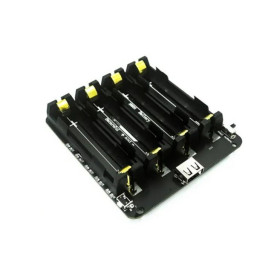


Product images are for informational purposes only and may vary slightly depending on the batch and supplier. Product specifications and prices may be subject to change without notice. We do our best to provide accurate and complete product specifications, but they may not be completely accurate. If you encounter any such situation, please let us know.
The product is intended for specialists and requires qualified and authorized personnel. The product does not include assembly/use instructions . Putting the product into operation by unqualified persons leads to the loss of the warranty according to the Terms and Conditions on the site.
The specified technical parameters (current, power, etc.) represent maximum allowable values under ideal operating conditions. For safe use and optimal lifespan, it is recommended to operate the product continuously at no more than 50% of the specified maximum values.
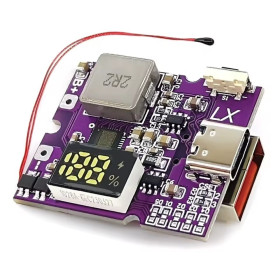
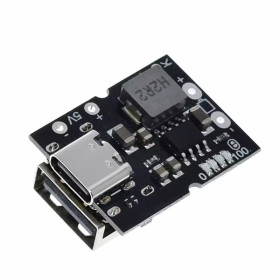
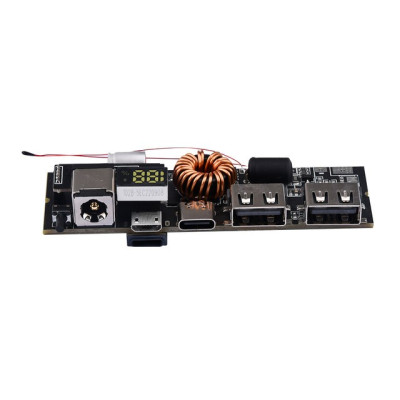
Powerbank module for 4S, QC4.0, QC3.0, PD, 5A, 100W, settable 2S, 3S, 5S and 6S
Powerbank module with fast and safe charging, ideal for DIY projects with 18650 batteries, pre-configured 4S and adjustable to 2S, 3S, 5S or 6S LiFePO4. Offers up to 100W and 5A with QC4.0, QC3.0 and PD support, has bidirectional USB-C and multiple ports for simultaneous powering of devices, includes BMS with cell monitoring and battery level display.
Shipping by Thursday 22 October
Buying this product earns you 1.51 € in loyalty points.

International fast shipping within EU. Free Shipping for orders above 100 EUR in most EU countries.

We ship from our stock within 24H

You earn points with every order, worth 5%.
The powerbank module is a complete lithium battery management board that turns a pack of 18650 or lithium-polymer cells into a high-power power bank with bidirectional fast charging. It is factory-set for a 4S configuration and can deliver up to 100W and 5A, enough for laptops, tablets, phones, or other high-power portable equipment. The board integrates support for most modern fast-charging protocols, including PPS, PD3.0, PD2.0, QC3+, QC3.0, QC2.0, AFC, FCP, SCP, and VOOC, ensuring compatibility with a very wide range of devices and chargers.
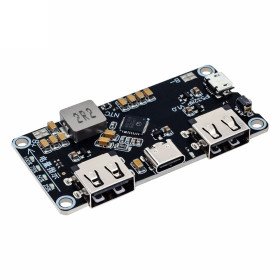
The board features five USB interfaces and one DC port: two female Type-A ports, one Type-C port that works for both charging and discharging, one MicroUSB port, one Lightning port, and a 5.5x2.5mm DC jack. The DC port accepts 5-12VDC and is intended exclusively for charging the pack, not for discharging. Type-C, Type-A1, and Type-A2 can supply power simultaneously, so multiple devices can be charged at the same time.
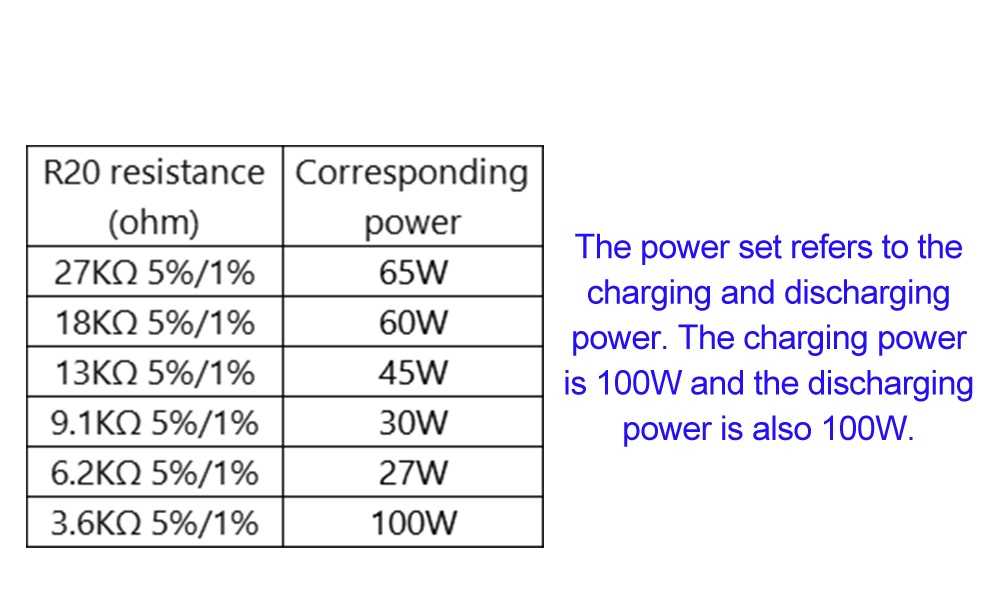
The feature that sets this module apart from similar solutions is its configuration flexibility. It works as 4S out of the box, but with simple board modifications it can be reconfigured for 2S, 3S, 5S, and 6S, with the last option reserved exclusively for LiFePO4 cells. The charging voltage per cell can be selected between 4.15V, 4.2V, 4.35V, 4.4V, and 3.65V, covering both lithium-ion and lithium-polymer chemistries, as well as lithium iron phosphate. By changing certain components, the declared battery capacity, maximum output power (27W, 30W, 45W, 60W, 65W, or 100W), and the temperature threshold for thermal protection can also be adjusted.
The cells are connected individually to the board through the balance line, which activates the BMS-type function for monitoring individual voltages and protecting against major cell imbalance. The board provides only four balance pads, so full monitoring is possible up to 4S inclusive. In 5S or 6S configurations, the balance line is no longer fully connected, and the individual cell monitoring function will not be active, which is why the pack needs its own protection board.
The integrated display shows the pack charge level, and a thermistor mounted on the cells allows the module to monitor temperature and intervene when the critical threshold is reached. With dimensions of only 72 x 27 x 6mm, the board fits easily into custom enclosures, portable power stations, or DIY high-capacity power bank projects. The 5V USB ports can easily power Arduino UNO, Arduino Nano, Arduino Mega, ESP32, ESP8266, STM32, or Raspberry Pi Pico development boards, making it a practical mobile power solution for embedded projects.
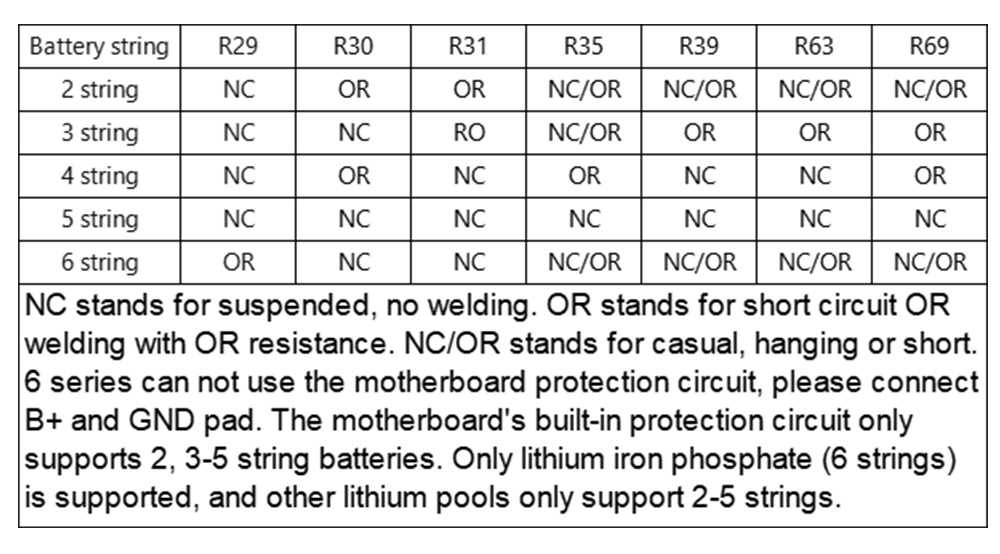
Resistors R63 and R69 are located near the balance connector and are unmarked. R69 is located at the edge of the PCB. The wires between the pack and the module must support at least 10A. 16AWG wire or thicker is recommended.
Recommendations:
The DC port is only for charging the power bank, not for discharging.
The wires connected between the module and the battery must be able to handle up to 10A. We recommend using 16AWG wire.
The main board has its own protection chip, which supports only 2-5 cells in series. A 6-series LiFePO4 battery pack requires its own protection board, and the overcurrent protection threshold of that protection board must be greater than 15A; otherwise it cannot operate normally, which will severely damage the main board chip.
Due to the high current at the battery end, the battery must be soldered with thick wire for testing. It is not allowed to use crocodile clips to secure the pad for charging and discharging tests. Burning the module due to improper use voids the warranty.
4.15V/4.2V/4.35V/4.4V 18650 cells, polymer cells, and ternary lithium cells can be used to build the battery. A large single cell may be used. The capacity of a single battery string must not exceed 25000mAh, and the display will be inaccurate if the capacity is exceeded. 3.65V lithium iron phosphate batteries are supported, NOT disposable dry batteries, nickel-metal hydride, nickel-chromium, lead-acid batteries, etc. The battery must consist of at least 2 in series and at most 6 in series, and the total voltage must not exceed 23V. The minimum charging and discharging capacity of a single cell string must be greater than 10A. If not, please reduce the power.
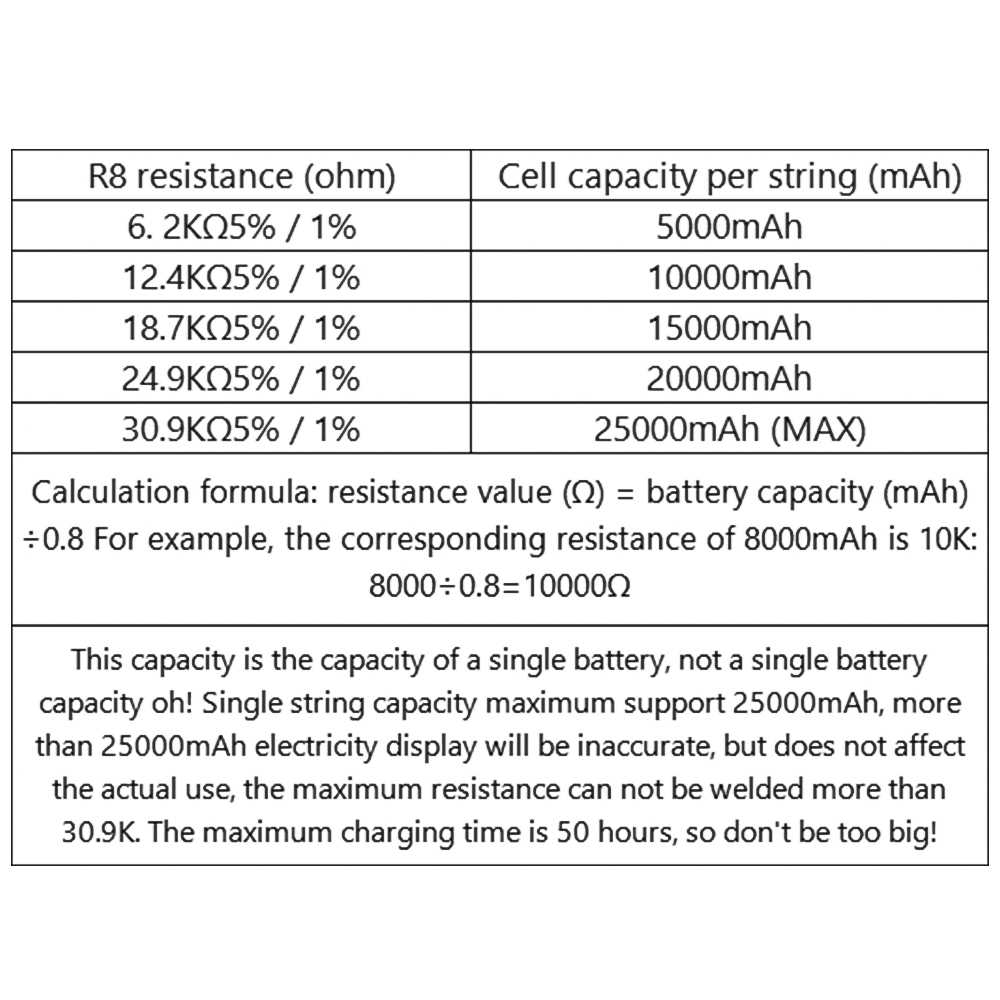
The battery capacity on the main board must be preset. Please refer to the instructions on the page.
Supports OPO flash charging and HW super fast charging. Different protocols have different power levels. 65W and 100W are PD protocol power levels. VOOC is 20W, and SCP is 22.5W.
The battery connected to this motherboard must meet the requirements and be connected in series. The battery used must be a quality one (for example, avoid 18650 batteries advertised as 10000mAh but weighing 20 grams and costing 10 Lei. These are not batteries, they are empty tubes), with low internal resistance. All cells used must be of the same type, same voltage, same capacity, and same internal resistance.
The wire connecting the battery to the main board must be thick, and the battery must be able to pass over 10A through the wire without heating up.
Specifications:
Battery type: Lithium-polymer
Battery configuration: 4S factory default, adjustable 2S, 3S, 4S, 5S, and 6S
Maximum output power: 100W factory default, adjustable 27W, 30W, 45W, 60W, 65W
USB ports: Type-C, Lightning, MicroUSB, Type-A1 and Type-A2.
DC port: 5.5x2.5
DC port supply voltage: 5-12VDC
Lightning: supports PD2.0 fast charging input
Type-C: supports AFC/FCP/SCP/VOOC/PD3.0/PD2.0 fast charging input
Fast charging output support: PPS/PD3.0/PD2.0/AFC/FCP/QC3+/QC3.0/QC2.0/SCP
Type-A1/Type-A2: supports Apple/AFC/FCP/VOOC/QC3+/QC3.0/QC2.0/SCP fast charging output
MicroUSB: supports AFC/FCP/SCP fast charging input
Type-C: supports bidirectional fast charging input and output
Input supports voltages of: 5V/9V/12V/15V/20V
PPS output: supports 3.3V-21V/3A
PD3.0/PD2.0 output: supports 5V3A/9V3A/12V3A/15V3A/20V5A
QC2.0 output: supports 5V3A/9V3A/12V3A
QC3.0: supports output voltages from 5V to 12V, in 200mV steps
AFC output: supports 5V3A/9V2A/12V2A
DC input: supports 5V/9V/12V voltages
FCP output: supports 5V3A/9V2A/12V1.5A
SCP output: supports 5V4.5A and 10V2.2A
VOOC output: supports 5V@4A
Type-A1/Type-A2/Type-C interface: can discharge at the same time
Dimensions mm: 72 x 27 x 6mm
Warning!
The wires between the pack and the module must support at least 10A. 16AWG wire or thicker is recommended.
The battery must be soldered with thick wire even for testing. Using crocodile clips on the pads to test charging and discharging is prohibited. Damage to the module caused by improper use voids the warranty.
The protection chip on the board covers only configurations of 2 to 5 cells in series. A 6-cell series LiFePO4 pack requires its own protection board, with an overcurrent protection threshold above 15A. Without it, the main board chip may be severely damaged.
Do not use disposable dry batteries, nickel-metal hydride, nickel-cadmium, or lead-acid batteries.
Avoid counterfeit 18650 cells with unrealistically high declared capacities and very low weight. These cannot supply the current required by the module.
Do not exceed 21V total pack voltage.
The 65W and 100W outputs are obtained only through the PD protocol. VOOC delivers 20W, and SCP 22.5W.
Usage:
Select the cells for the pack. All must be of the same type, same capacity, same voltage, and with as closely matched internal resistance as possible.
Check that the pack complies with the board limits: minimum 2 cells in series, maximum 6 cells in series, total voltage below 23V, and capacity per string below 25000mAh.
If you use a configuration other than 4S or a chemistry other than 4.2V lithium-ion, first make the board modifications for the number of cells and the per-cell voltage before connecting the pack.
Set the battery capacity on the board, otherwise the display reading will be incorrect.
Solder the power wires between the pack and the battery pads, using at least 16AWG wire, capable of carrying over 10A without heating.
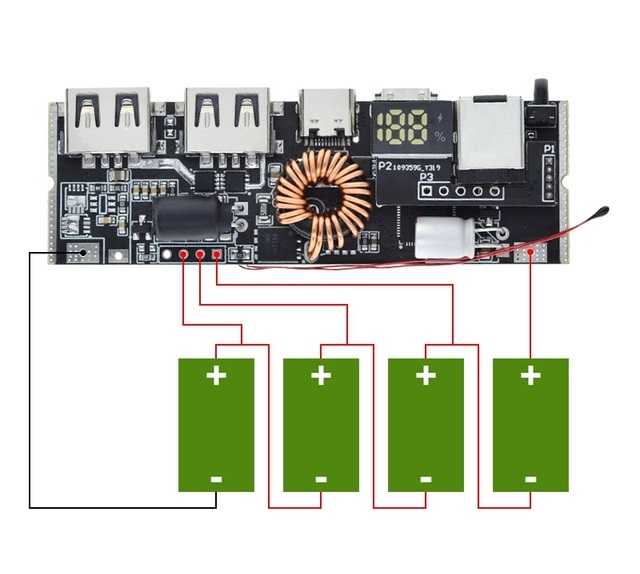
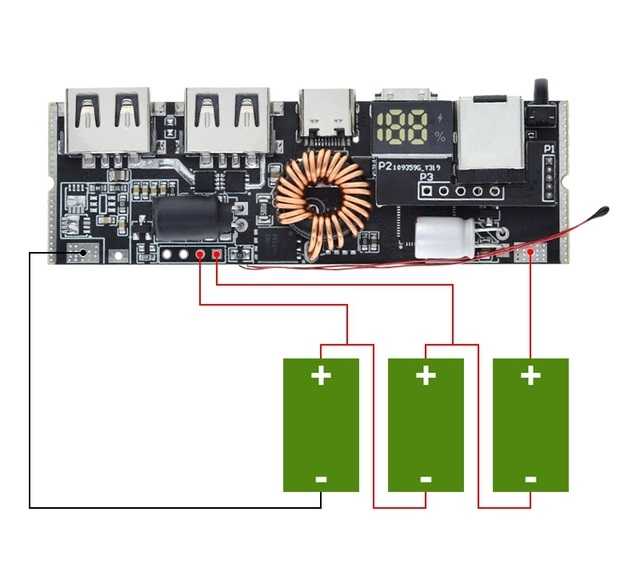
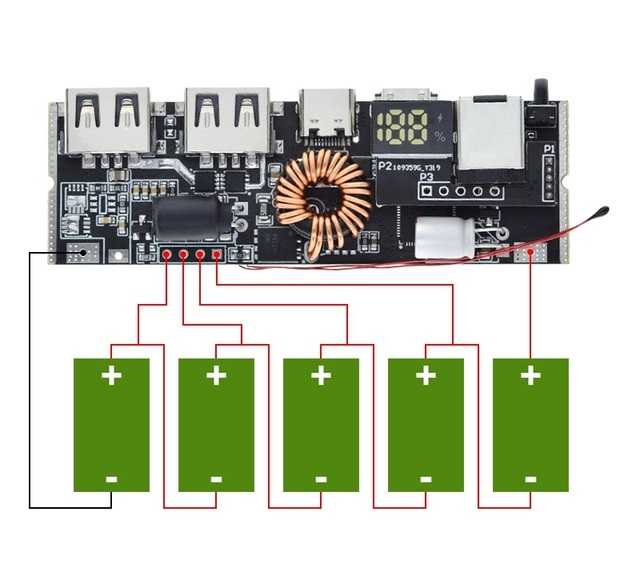
Connect the balance line to the four pads, observing the order of the cells in series, to activate individual monitoring.
Attach the thermistor to the cell bodies so that thermal protection reads the actual pack temperature.
Check polarity and the absence of short circuits once more, then power the module with a 5V charger or with a QC or PD charger through the Type-C, MicroUSB, Lightning, or DC port.
Watch the display for the charge level and wait for automatic charging stop.
Connect loads to the Type-A1, Type-A2, or Type-C ports, keeping in mind that the DC port cannot be used for discharging.
Cell connection in 4S:
Cell connection in 3S (after board modification):
Cell connection in 5S (after board modification):
Board parameter modification:
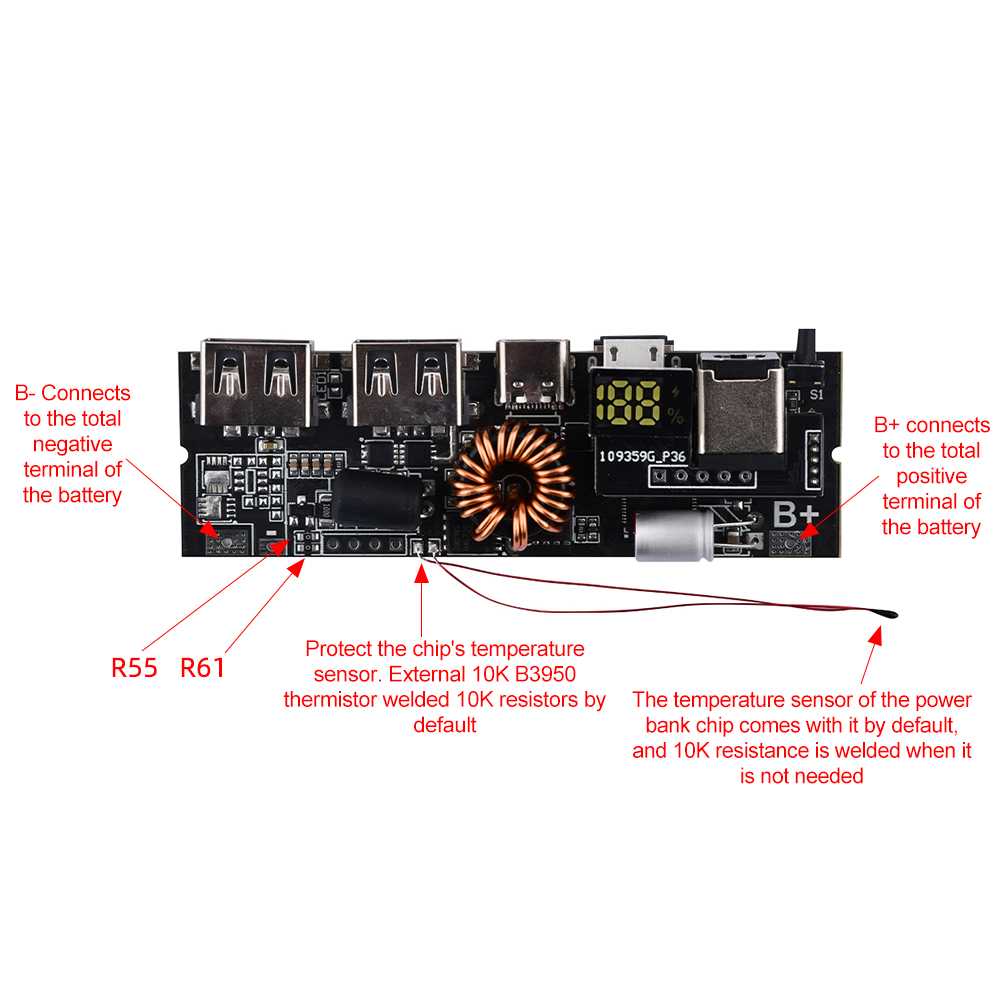
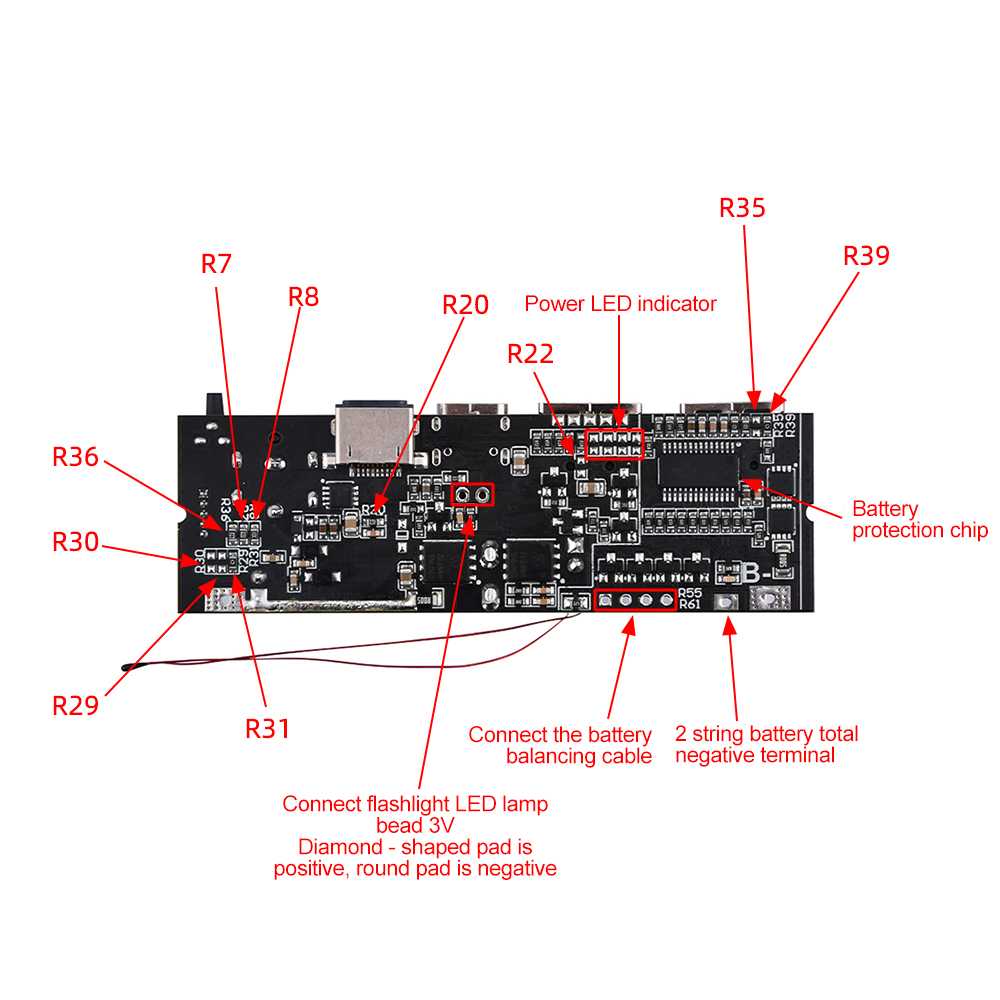
Resistors R63 and R69 are located near the balance connector and are unmarked. R69 is located at the edge of the PCB.
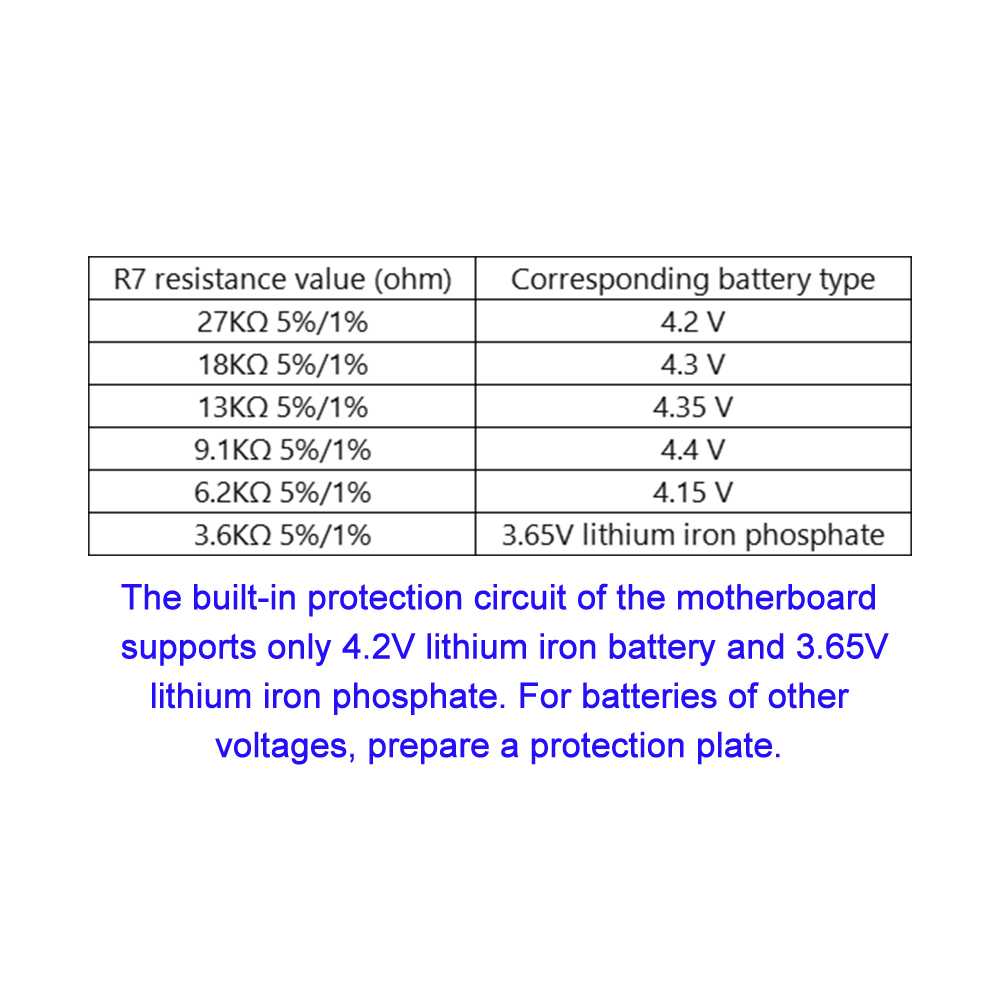
Cell voltage parameters:
Series cell parameter modification:
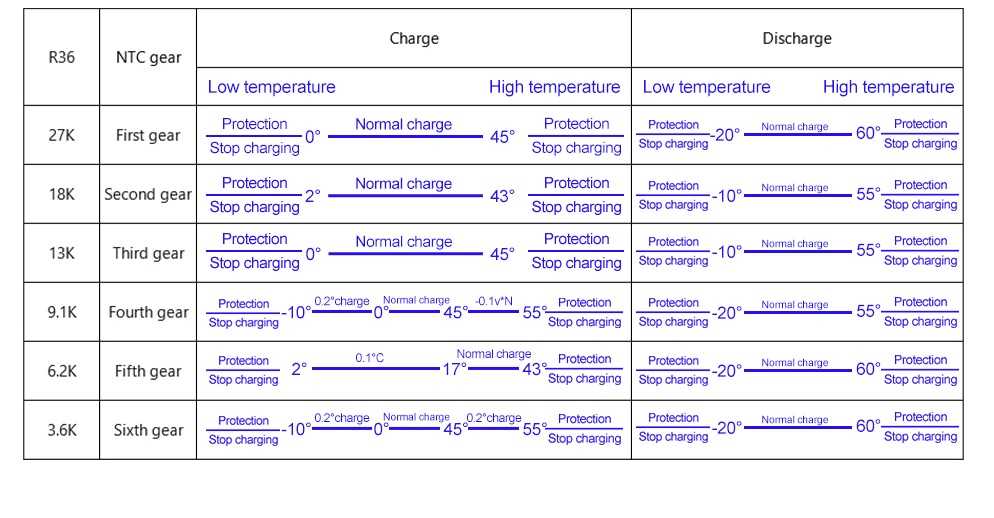
Temperature parameter modification:
Power parameter modification:
Battery capacity parameter modification:
- Load voltage
- 16.8VDC
- Power
- Over 20W
- Number of cells
- 4S
- Maximum Output Current
- 5
Produs destinat utilizarii in proiecte electronice, automatizari, prototipare, educatie si cercetare.
Produsul trebuie utilizat numai conform specificatiilor tehnice mentionate in descriere si/sau in documentatia produsului.
Avertismente generale de siguranta:
Nu utilizati produsul la tensiuni, curenti sau temperaturi peste valorile specificate.
Montajul si conectarea trebuie realizate de persoane cu cunostinte tehnice minime in domeniul electric/electronic.
Evitati scurtcircuitele, inversarea polaritatii si conectarea gresita a alimentarii.
Nu lasati produsul alimentat nesupravegheat in timpul testelor.
Produsul nu este jucarie si nu este destinat copiilor.
Pentru modulele electronice, se recomanda utilizarea in carcase, panouri sau montaje protejate, dupa caz.
Identificare produs:
Denumirea produsului, codul/SKU-ul si caracteristicile tehnice sunt mentionate in pagina produsului si/sau pe eticheta ambalajului.
Producator / Importator / Distribuitor:
Sigmanortec S.R.L.
Calea Bucuresti nr. 9, Targu Jiu, Gorj, Romania
E-mail: [email protected]
Website: www.sigmanortec.ro
Persoana responsabila in UE:
Sigmanortec S.R.L.
Calea Bucuresti nr. 9, Targu Jiu, Gorj, Romania
E-mail: [email protected]
Documentatie si siguranta:
Pentru informatii suplimentare, fise tehnice, declaratii de conformitate sau instructiuni, ne puteti contacta la [email protected].