
Product images are for informational purposes only and may vary slightly depending on the batch and supplier. Product specifications and prices may be subject to change without notice. We do our best to provide accurate and complete product specifications, but they may not be completely accurate. If you encounter any such situation, please let us know.
The product is intended for specialists and requires qualified and authorized personnel. The product does not include assembly/use instructions . Putting the product into operation by unqualified persons leads to the loss of the warranty according to the Terms and Conditions on the site.
The specified technical parameters (current, power, etc.) represent maximum allowable values under ideal operating conditions. For safe use and optimal lifespan, it is recommended to operate the product continuously at no more than 50% of the specified maximum values.
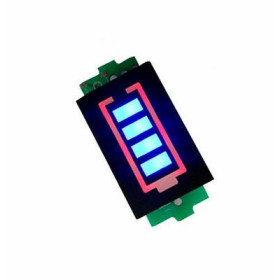
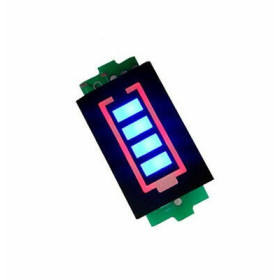
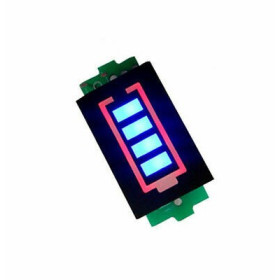
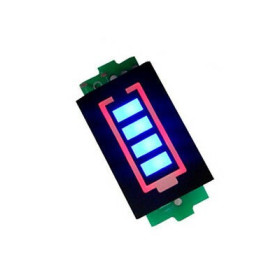
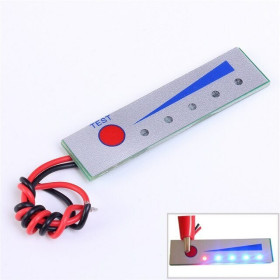
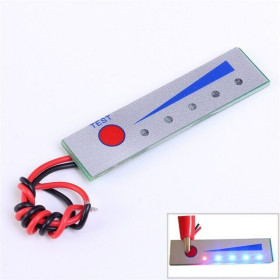
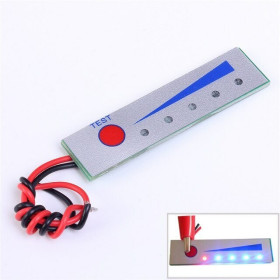
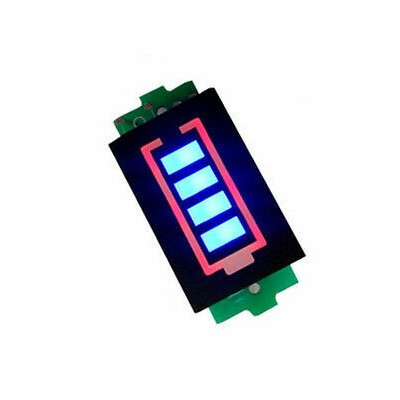
Battery level indicator module 1S, 3.3 - 4.2V, 4 segments, blue and red display, 43.5 x 20 mm
Quickly displays the charge level for a 1S lithium cell between 3.3 and 4.2V, with 4 blue bars for 25, 50, 75 and 100% and a red outline when it drops below 25%. It operates at 3.7V DC with low consumption of approximately 5mA, it is compact, 43.5 x 20mm, ideal for portable projects and electronic equipment.
Buying this product earns you 0.34 RON in loyalty points.

International fast shipping within EU. Free Shipping for orders above 100 EUR in most EU countries.

We ship from our stock within 24H

You earn points with every order, worth 5%.
The battery level indicator module displays the charge status of a 1S lithium battery using a battery-shaped display with 4 blue segments and a red frame. It connects directly to the cell terminals and shows at a glance how charged it is, making it suitable for 3.7 V batteries in portable projects, flashlights, homemade power banks, toys, battery-powered devices, and battery packs.
The module measures the cell voltage and lights up 1, 2, 3, or 4 segments depending on the level. The first segment lights at 3.3 V (25%), the second at 3.5 V (50%), the third at 3.7 V (75%), and the fourth at 3.9 V (100%). When the battery level drops below 25%, only the red battery-shaped frame remains lit. The indication works both during discharge and charging. Ni-MH batteries can also be used, provided their voltage falls within the 3.3 - 4.2 V range.
Among the main features are the display with 4 blue segments and red frame, low power consumption of about 5 mA, compact dimensions of 43.5 x 20 mm, and one mounting hole at each of the two ends of the board. The module has no buttons or adjustments and does not require separate power, being powered directly by the cell it monitors.
Specifications:
Supply voltage: 3.7 VDC (1 x 3.7 V lithium battery)
Current consumption: 5 mA
Battery type: 1S lithium, 4.2 V when fully charged
Voltage range: 3.3 - 4.2 V
25% level: 3.3 V
50% level: 3.5 V
75% level: 3.7 V
100% level: 3.9 V
Display: 4 blue segments and red battery-shaped frame
Dimensions: 43.5 x 20 mm
Layout:
| Element | Function |
|---|---|
| Blue segments (4 bars) | Indicate charge level. An additional segment lights up at each voltage threshold: 3.3 V, 3.5 V, 3.7 V, and 3.9 V. |
| Red battery-shaped frame | Outlines the battery symbol. When the level drops below 25%, it is the only lit element. |
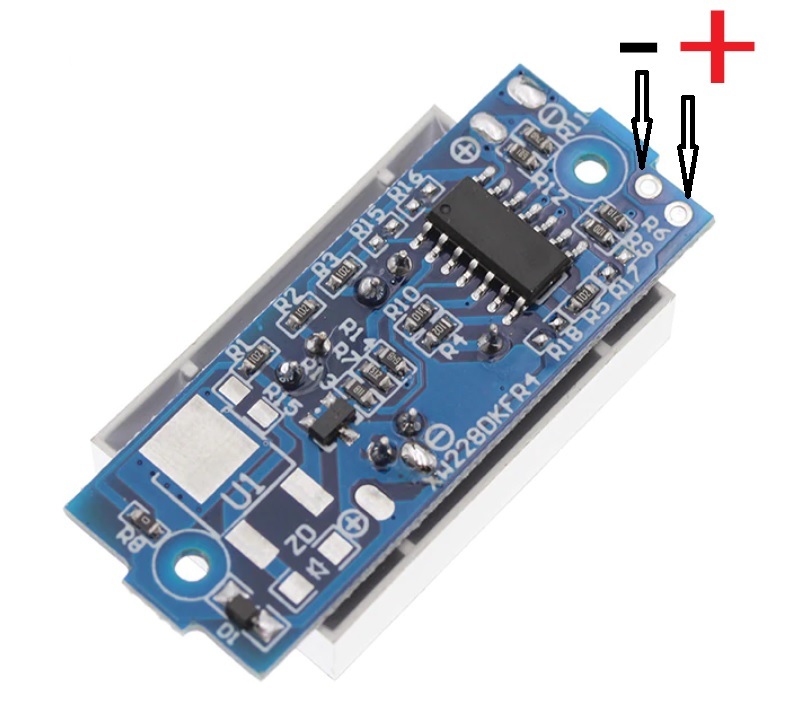
| B+ power pad | Connects to the positive terminal of the battery. |
| B- power pad | Connects to the negative terminal of the battery. |
| Mounting holes | One at each end of the board, for securing the module. |
Pinout:
| Connector | Pin | Function |
|---|---|---|
| Power pad | B+ | Positive terminal of the 1S battery |
| Power pad | B- | Negative terminal of the battery (GND) |
Usage:
Check the polarity markings on the board before soldering and identify the B+ and B- pads.
Solder one wire to each pad, respecting polarity, then connect the wires to the battery terminals: B+ to positive and B- to negative.
Do not reverse polarity and do not apply a voltage higher than 4.2 V, as the module is intended for a single lithium cell.
After connection, the display lights up immediately and shows the current level. The number of blue segments lit corresponds to the 25%, 50%, 75%, and 100% thresholds.
If only the red frame is lit, the battery voltage is below 3.3 V and it should be recharged.
The module has no buttons, jumpers, or potentiometers, so no setup is required. It can remain connected in parallel with the battery during charging, to see the level rise.
The module consumes about 5 mA while connected, so install a switch on the power wire or disconnect the module when the battery is not used for long periods.
For correct indication, measure the battery voltage at rest or under light load, since at high currents the voltage drops temporarily and fewer segments may be shown.
Secure the module through the mounting holes at the two ends of the board, avoiding contact between the soldered pads and metal parts.
- Supply voltage
- 3.7 V DC
- Dimensions
- 43.5 x 20 mm
- Power consumption
- 5 mA
- Display
- 4 segments
- Configuration
- 1S
- Voltage measuring range
- 3.3-4.2 V
- Display colour
- Blue with red
- Battery type
- Lithium 1S
Produs destinat utilizarii in proiecte electronice, automatizari, prototipare, educatie si cercetare.
Produsul trebuie utilizat numai conform specificatiilor tehnice mentionate in descriere si/sau in documentatia produsului.
Avertismente generale de siguranta:
Nu utilizati produsul la tensiuni, curenti sau temperaturi peste valorile specificate.
Montajul si conectarea trebuie realizate de persoane cu cunostinte tehnice minime in domeniul electric/electronic.
Evitati scurtcircuitele, inversarea polaritatii si conectarea gresita a alimentarii.
Nu lasati produsul alimentat nesupravegheat in timpul testelor.
Produsul nu este jucarie si nu este destinat copiilor.
Pentru modulele electronice, se recomanda utilizarea in carcase, panouri sau montaje protejate, dupa caz.
Identificare produs:
Denumirea produsului, codul/SKU-ul si caracteristicile tehnice sunt mentionate in pagina produsului si/sau pe eticheta ambalajului.
Producator / Importator / Distribuitor:
Sigmanortec S.R.L.
Calea Bucuresti nr. 9, Targu Jiu, Gorj, Romania
E-mail: [email protected]
Website: www.sigmanortec.ro
Persoana responsabila in UE:
Sigmanortec S.R.L.
Calea Bucuresti nr. 9, Targu Jiu, Gorj, Romania
E-mail: [email protected]
Documentatie si siguranta:
Pentru informatii suplimentare, fise tehnice, declaratii de conformitate sau instructiuni, ne puteti contacta la [email protected].
Reviews (1) - Review moderation

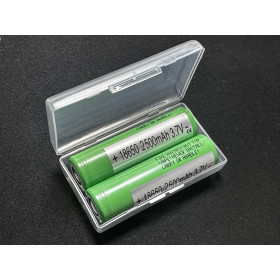
The 1S battery level indicator module is a standalone module that works on its own, without a development board and without any program. It is powered directly by the lithium cell it monitors, so in this tutorial we use only a 3.7 V 18650 Li-ion battery in a single-cell holder.
We use it in portable projects, flashlights, power banks or battery cases, anywhere we want to see quickly how much of the battery's energy is left.

How it works:
The module continuously measures the voltage at the cell terminals and compares it with four thresholds. A Li-ion cell has 4.2 V when fully charged, about 3.7 V nominal, and drops towards 3.3 V when it is almost empty. For this reason, the voltage is a simple and useful indicator of the charge level.
The thresholds for the 1S version are: 3.3 V for 1 segment (25%), 3.5 V for 2 segments (50%), 3.7 V for 3 segments (75%) and 3.9 V for 4 segments (100%). Below 3.3 V only the red battery-shaped frame lights up.
The module consumes approximately 5 mA continuously. For a 2500 mAh cell, this means approximately 2500 mAh / 5 mA = 500 hours, which is just over 20 days, powering only the module. That is why it is useful to disconnect it when the battery is not in use.
Connection:
The module has only two connections, directly to the battery terminals. It has no logic level and does not need a converter, resistors or a separate power supply. The correct power source is a single 3.7 V lithium cell, with a maximum of 4.2 V when fully charged.
| Product pin | Connect to | Role |
|---|---|---|
| B+ | Positive terminal of the 18650 battery (red wire of the holder) | Power supply and voltage measurement |
| B- | Negative terminal of the 18650 battery (black wire of the holder) | Ground |
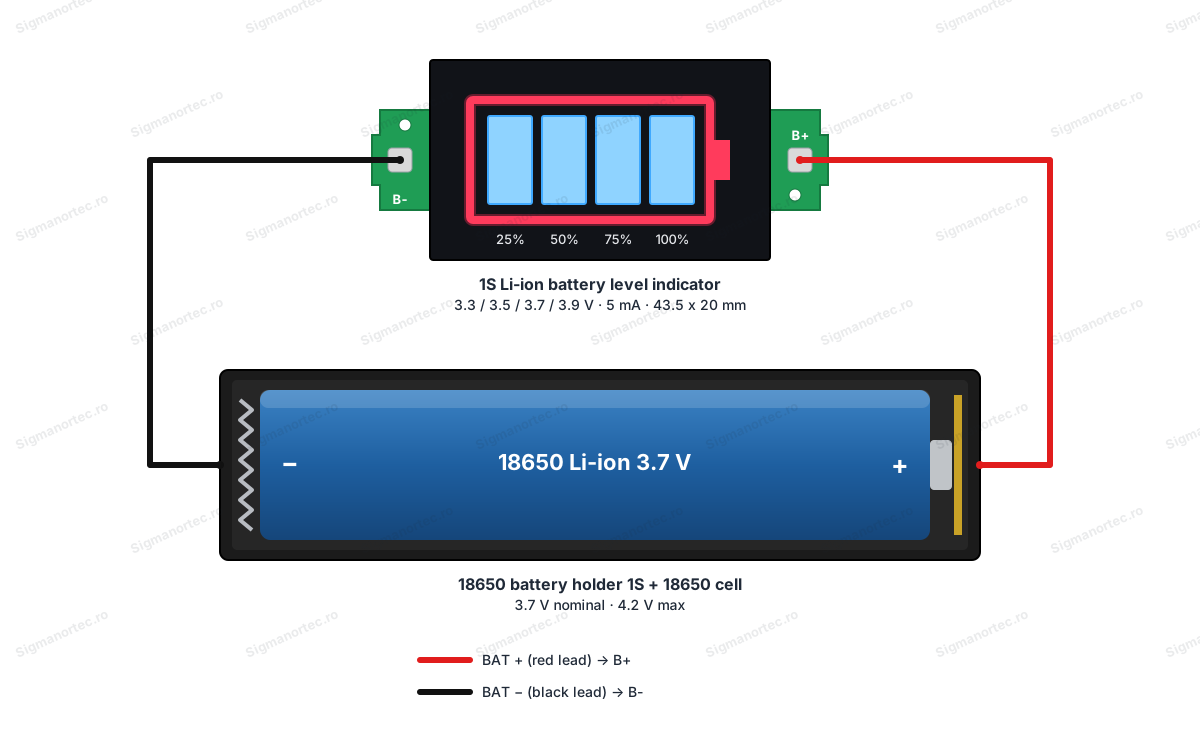
Before soldering, check the + and - markings printed on the actual board, because incorrect polarity can damage the module.
Configuration:
The module has no buttons, jumpers or potentiometers, so there is nothing to set. The 1S version is fixed for a single cell. The only thing to interpret is the display, described in the table below.
| Cell voltage | Display | Level |
|---|---|---|
| Below 3.3 V | Red frame only | Below 25% |
| Above 3.3 V | 1 blue segment | 25% |
| Above 3.5 V | 2 blue segments | 50% |
| Above 3.7 V | 3 blue segments | 75% |
| Above 3.9 V | 4 blue segments | 100% |
The module has no memory and does not store settings. The display updates automatically, according to the cell voltage, as soon as it is powered.
Usage example:
Let us assume we want a level indicator for a flashlight powered by an 18650 cell. Solder one wire to the B+ and B- pads of the module, respecting the markings on the board, and connect them to the positive and negative terminals of the cell or to the contacts of its holder.
Mount a small switch on the positive wire, between the battery and the module, to avoid the 5 mA consumption when the flashlight is not in use. Fix the module in the case through the holes at the two ends.
For a cell freshly charged to 4.2 V, all 4 blue segments light up. As the flashlight runs, the voltage drops and the segments turn off one by one at 3.9 V, 3.7 V, 3.5 V and 3.3 V. When only the red frame remains lit, the battery is below 25% and must be recharged. If you put the cell on charge with the module connected, the segments light up again one by one.
Common problems:
The display stays off. The most likely cause is reversed polarity, a missing contact or a fully discharged battery. Check the + and - markings on the board, the solder joints and the cell voltage with a multimeter.
Only the red frame lights up although the battery seems charged. The measured voltage is below 3.3 V, either because the cell is discharged or because the wires are thin or long and cause a voltage drop. Use short wires and measure the voltage directly at the cell terminals.
The number of segments drops when you turn on the load. At high current the cell voltage drops temporarily, and the module shows a lower level. After the load is switched off, the level returns to the real value.
The battery discharges by itself after a few weeks. The module consumes approximately 5 mA continuously, so add a switch or disconnect the module for storage.
The indication does not match a pack with several cells. The 1S version is made for a single cell, and for 2S or larger packs you need the corresponding module.
Limitations and tips:
The module is intended for a single lithium cell, with a voltage between 3.3 and 4.2 V, and must not be connected to higher voltages. It can also be used with Ni-MH batteries, but only if their voltage stays within this range.
The indication is approximate, being based only on voltage, with four steps of 25% each, and it depends on the load and the temperature. It does not replace an energy meter and does not protect the battery against over-discharge or overcharge, so use it together with a protection or charging module.
You can integrate it into battery cases, portable projects and equipment powered by batteries, as a simple visual level indicator.