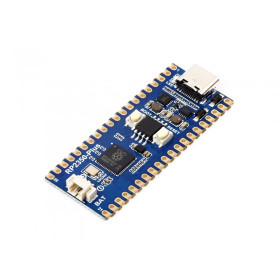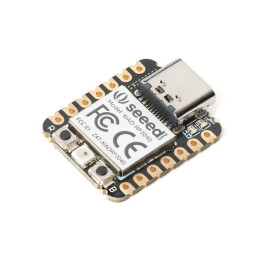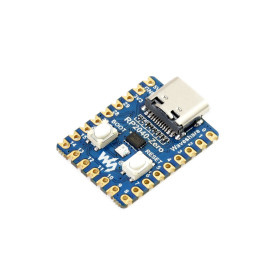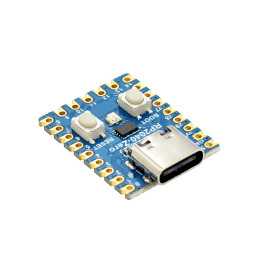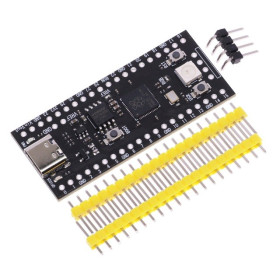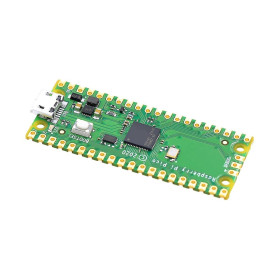


Product images are for informational purposes only and may vary slightly depending on the batch and supplier. Product specifications and prices may be subject to change without notice. We do our best to provide accurate and complete product specifications, but they may not be completely accurate. If you encounter any such situation, please let us know.
The product is intended for specialists and requires qualified and authorized personnel. The product does not include assembly/use instructions . Putting the product into operation by unqualified persons leads to the loss of the warranty according to the Terms and Conditions on the site.
The specified technical parameters (current, power, etc.) represent maximum allowable values under ideal operating conditions. For safe use and optimal lifespan, it is recommended to operate the product continuously at no more than 50% of the specified maximum values.
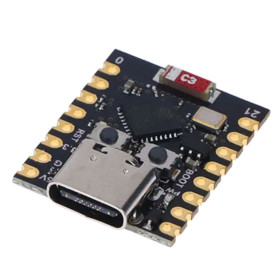
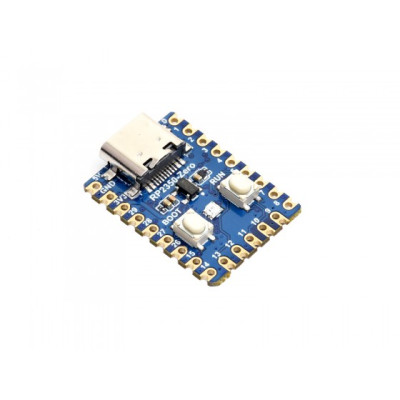
Waveshare Zero Mini Development Board, RP2350
The ultra-compact development board for projects where space matters can be soldered directly onto a PCB thanks to its castellated edges. It includes the RP2350A with a choice between Arm Cortex-M33 or RISC-V up to 150 MHz, 4 MB Flash and 520 KB SRAM, 29 GPIO with SPI, I2C, UART, ADC, PWM, and PIO for custom protocols. Simple programming via USB Type-C, plus an integrated WS2812 RGB LED.
Shipping by Thursday 22 October
Buying this product earns you 0.73 € in loyalty points.

International fast shipping within EU. Free Shipping for orders above 100 EUR in most EU countries.

We ship from our stock within 24H

You earn points with every order, worth 5%.
The Waveshare RP2350 Zero Mini development board is a high-performance miniature MCU solution, built around the RP2350A microcontroller and designed for projects where space is critical. Measuring just 18 x 23.5 mm and featuring castellated edges, this board can be soldered directly onto a custom PCB, eliminating the need for a connector and minimizing the system’s physical footprint. It is aimed at both electronics enthusiasts and professional developers who need a powerful microcontroller integrated directly into the final product.
The core of the board is the RP2350A microcontroller, which combines two processor architectures in a single chip: a dual-core Arm Cortex-M33 processor and a dual-core RISC-V Hazard3 processor, both running at clock frequencies of up to 150 MHz. The user can choose the architecture best suited to their application, benefiting from maximum flexibility without performance compromises. The board comes with 520 KB of SRAM and 4 MB of onboard NOR Flash memory (P25Q32SH-UXH-IR), enough for complex data acquisition, automation, or communications applications.
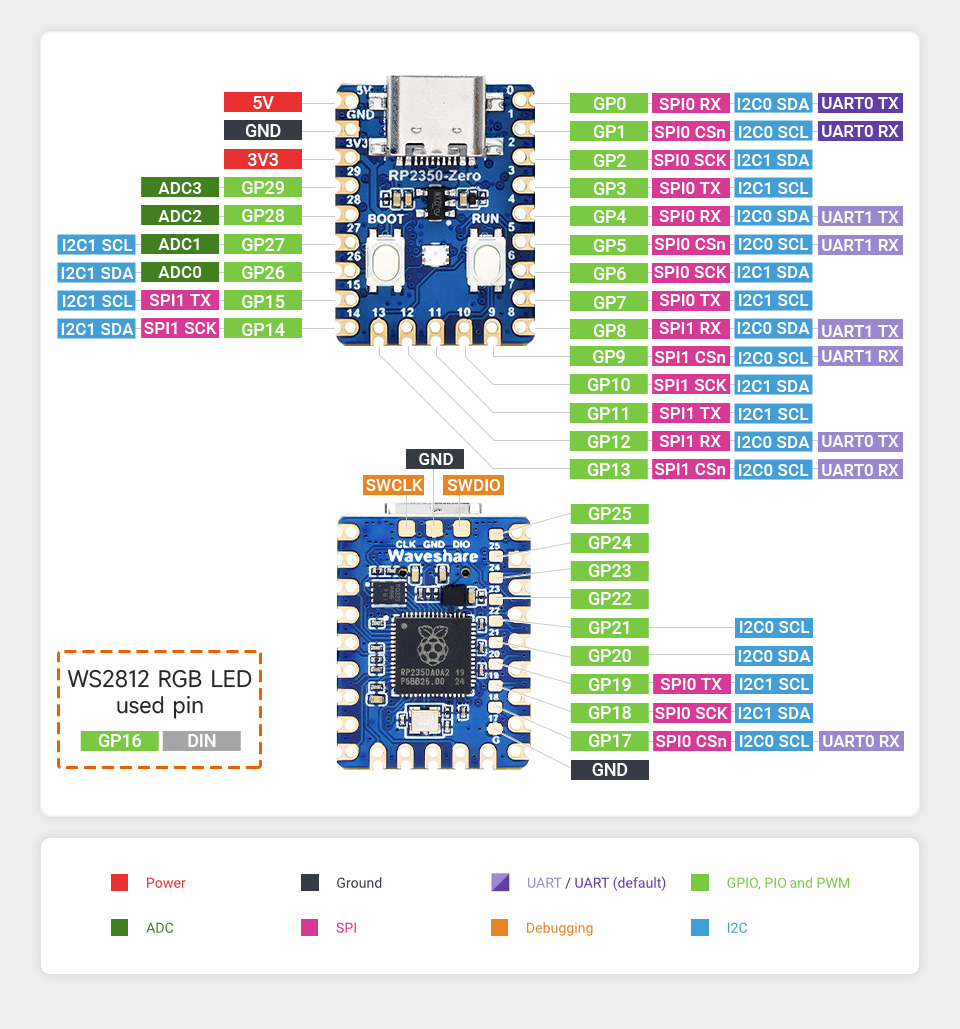
The 29 multifunction GPIO pins provide rich connectivity: 2 SPI interfaces, 2 I2C interfaces, 2 UART interfaces, 4 12-bit ADC channels, and 16 PWM channels. Of these, 20 pins are accessible through the edge header, while the rest are available via dedicated solder pads. The 12 PIO state machines allow custom communication protocols to be implemented directly in hardware. A distinctive feature of this board is the integrated WS2812 RGB LED, controllable via a single data wire, useful for visual status indicators in any application. The ME6217C33M5G LDO regulator provides a stable 3.3 VDC output with a maximum current of 800 mA. Power and programming are handled through the USB Type-C connector with USB 1.1 support, and the board also includes BOOT and RUN buttons for entering download mode and resetting the system, respectively.
The board is compatible with Arduino IDE (via the Raspberry Pi Pico/RP2040 package by Earle F. Phillhower III), MicroPython, CircuitPython, and Pico SDK (C/C++), making it accessible to a wide range of users.
Specifications:
Microcontroller: RP2350A
Processors: Dual-core Arm Cortex-M33 or dual-core RISC-V Hazard3, up to 150 MHz
SRAM Memory: 520 KB
Flash Memory: 4 MB NOR (P25Q32SH-UXH-IR)
Programming interface: USB 1.1 via USB Type-C
Voltage regulator: ME6217C33M5G (LDO, maximum output 800 mA)
GPIO: 29 multifunction pins (20 via edge header, the rest via solder pads)
Hardware interfaces: 2x SPI, 2x I2C, 2x UART, 4x ADC (12-bit), 16x PWM
PIO: 12 programmable state machines
Indicator: WS2812 RGB LED
Buttons: BOOT (download mode) and RUN (reset)
Software compatibility: Arduino IDE, MicroPython, CircuitPython, Pico SDK (C/C++)
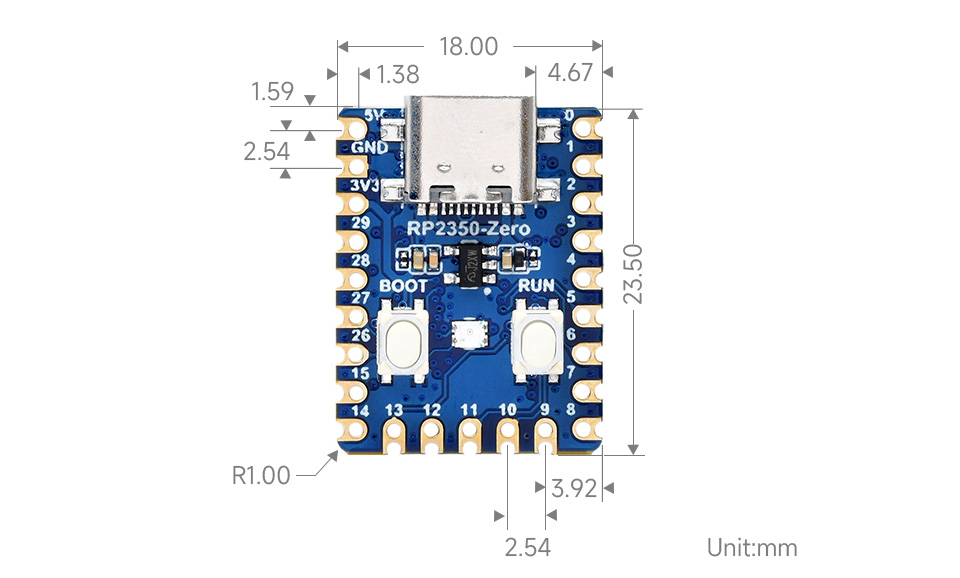
Dimensions: 18 x 23.5 mm
Layout:
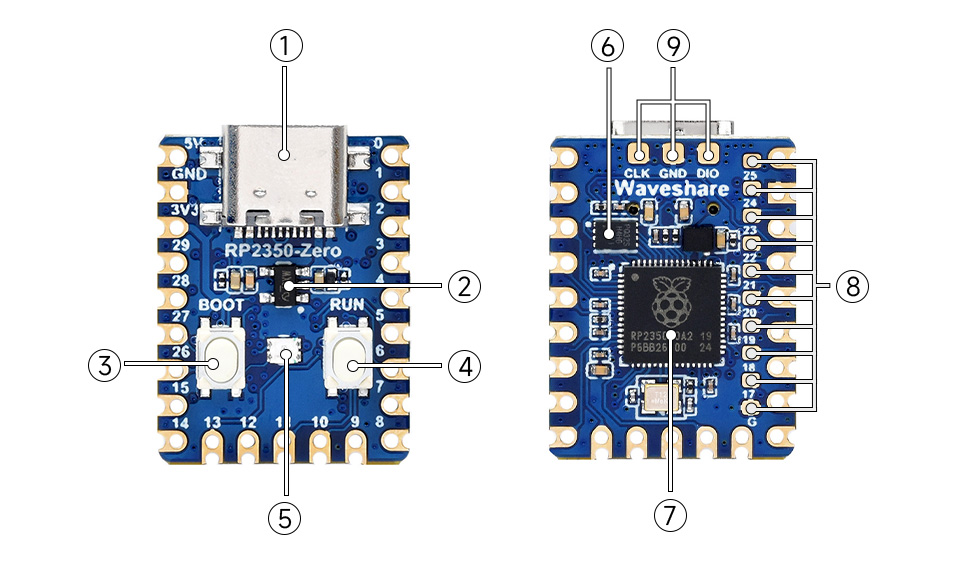
1. USB Type-C connector
2. ME6217C33M5G: LDO voltage regulator, maximum output 800 mA
3. BOOT button
4. RUN button
5. WS2812: RGB LED
6. P25Q32SH-UXH-IR: 4 MB NOR Flash memory
7. RP2350A microcontroller
8. RP2350A pins: 10 solder pads, of which 9 are GPIO pins
9. DEBUG pins
Pinout:
Usage:
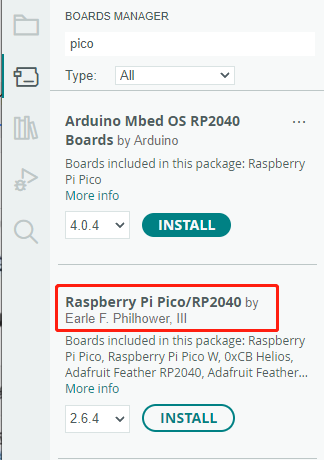
To program the board with Arduino IDE, add the following link in the preferences section of Arduino IDE (File > Preferences): https://github.com/earlephilhower/arduino-pico/releases/download/4.5.2/package_rp2040_index.json

Then, from Board Manager, install Raspberry Pi Pico/RP2040 by Earle F. Phillhower, III.
When you connect the board to a computer via a USB Type-C cable and hold down the BOOT button, a drive named RPI-RP2 will appear on the computer.
Dimensions:
- Microcontroller
- RP2350
Produs destinat utilizarii in proiecte electronice, automatizari, prototipare, educatie si cercetare.
Produsul trebuie utilizat numai conform specificatiilor tehnice mentionate in descriere si/sau in documentatia produsului.
Avertismente generale de siguranta:
Nu utilizati produsul la tensiuni, curenti sau temperaturi peste valorile specificate.
Montajul si conectarea trebuie realizate de persoane cu cunostinte tehnice minime in domeniul electric/electronic.
Evitati scurtcircuitele, inversarea polaritatii si conectarea gresita a alimentarii.
Nu lasati produsul alimentat nesupravegheat in timpul testelor.
Produsul nu este jucarie si nu este destinat copiilor.
Pentru modulele electronice, se recomanda utilizarea in carcase, panouri sau montaje protejate, dupa caz.
Identificare produs:
Denumirea produsului, codul/SKU-ul si caracteristicile tehnice sunt mentionate in pagina produsului si/sau pe eticheta ambalajului.
Producator / Importator / Distribuitor:
Sigmanortec S.R.L.
Calea Bucuresti nr. 9, Targu Jiu, Gorj, Romania
E-mail: [email protected]
Website: www.sigmanortec.ro
Persoana responsabila in UE:
Sigmanortec S.R.L.
Calea Bucuresti nr. 9, Targu Jiu, Gorj, Romania
E-mail: [email protected]
Documentatie si siguranta:
Pentru informatii suplimentare, fise tehnice, declaratii de conformitate sau instructiuni, ne puteti contacta la [email protected].
// Waveshare RP2350-Zero - WS2812 RGB LED test
// The onboard WS2812 RGB LED is connected to GP16
#include <Adafruit_NeoPixel.h>
#define LED_PIN 16
#define NUM_LEDS 1
Adafruit_NeoPixel strip(NUM_LEDS, LED_PIN, NEO_GRB + NEO_KHZ800);
void setup() {
strip.begin();
strip.setBrightness(50);
strip.show();
}
void loop() {
// Red
strip.setPixelColor(0, strip.Color(255, 0, 0));
strip.show();
delay(500);
// Green
strip.setPixelColor(0, strip.Color(0, 255, 0));
strip.show();
delay(500);
// Blue
strip.setPixelColor(0, strip.Color(0, 0, 255));
strip.show();
delay(500);
}