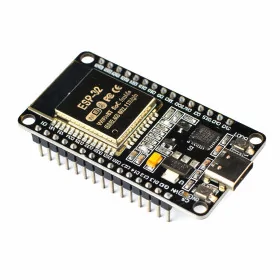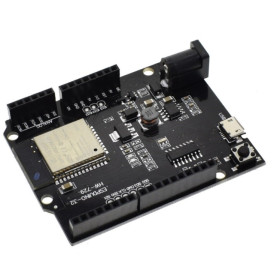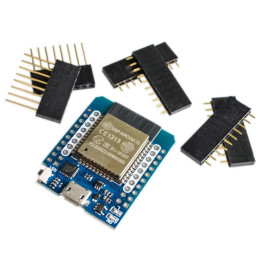


Product images are for informational purposes only and may vary slightly depending on the batch and supplier. Product specifications and prices may be subject to change without notice. We do our best to provide accurate and complete product specifications, but they may not be completely accurate. If you encounter any such situation, please let us know.
The product is intended for specialists and requires qualified and authorized personnel. The product does not include assembly/use instructions . Putting the product into operation by unqualified persons leads to the loss of the warranty according to the Terms and Conditions on the site.
The specified technical parameters (current, power, etc.) represent maximum allowable values under ideal operating conditions. For safe use and optimal lifespan, it is recommended to operate the product continuously at no more than 50% of the specified maximum values.
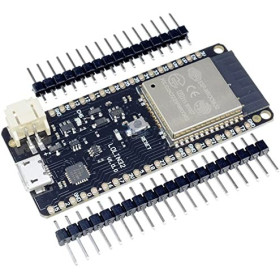
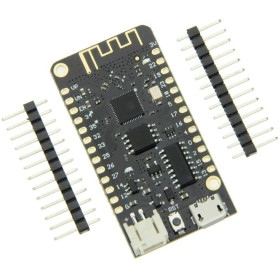
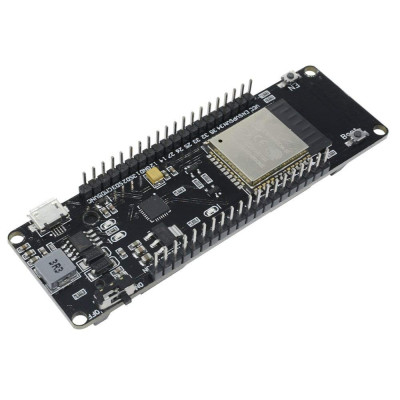
ESP32, CP2102, Bluetooth WiFi development board, with integrated powerbank
Compact solution for portable IoT projects, with integrated 18650 battery support and charging and protection circuitry. Offers 2.4GHz WiFi and Bluetooth connectivity for fast communication, easy USB programming with CP2102, plus status LED and programmable LED for visual feedback.
Shipping by Thursday 22 October
Buying this product earns you 2.88 RON in loyalty points.

International fast shipping within EU. Free Shipping for orders above 100 EUR in most EU countries.

We ship from our stock within 24H

You earn points with every order, worth 5%.
The ESP-32S WiFi development board compatible with WeMos is a practical solution for portable IoT projects, special because of the integrated rear support for a 18650 lithium battery.
The board includes a charging and protection circuit for charging and discharging, so it can be powered either from an external 5V source or directly from the battery.
You have integrated 2.4GHz dual mode WiFi and Bluetooth for quick network connection and communication with sensors or mobile devices, and programming is simplified through the USB interface with CP2102. The 4MB SPI Flash memory is integrated on the board, but it uses GPIO6, GPIO7, GPIO8, GPIO9, GPIO10, and GPIO11, which means these pins cannot be used as normal GPIO pins.
For visual feedback, the board has a charging status LED with green for charged and red for charging, plus a programmable LED on GPIO16.
With a 3000mAh 18650 battery, the board can operate continuously for approximately 17 hours or even longer, depending on the project's power consumption.
The board integrates 4 MB SPI memory, connected to GPIO6, GPIO7, GPIO8, GPIO9, GPIO10, and GPIO11. These pins cannot be used as normal GPIO pins.
Specifications:
Power supply voltage: 5V or 18650 battery, not included
WiFi: 802.11 b/g/n
Bluetooth: Yes
Programmer: CP2102 / CP2104
Chip: ESP32-S
SPI Flash Memory: 4MB
PSRAM: 0 (none)
LED: Charging status, Green charged, Red charging
Programmable LED: GPIO 16, DO
Battery charging current: 0.5A
Output current: 1A
Protection: charging and discharging
Functions, pins, and features: standard ESP32
Protocols: LWIP, Freertos
Modes: AP, STA, and AP+STA
Support: Lua programming
Pinout:

Usage:
Insert a 18650 battery into the rear holder, respecting the plus and minus polarity marked on the PCB. Ignoring the polarity can cause irreversible damage!
For external power, connect the board to 5V via USB; the battery can charge automatically if installed.
At first use, install the driver for CP2102 if the system does not recognize it automatically.
Upload via USB: set the switch to ON and connect the USB.
If the upload does not start and remains at “Connecting...”, hold down BOOT when the upload starts, then release.
If the sketch does not run after upload, press EN/RESET once.
Program the board from Arduino IDE, PlatformIO, or other ESP32-compatible environments, selecting the appropriate ESP32 board.
Avoid using GPIO6, GPIO7, GPIO8, GPIO9, GPIO10, and GPIO11 pins, as they are reserved for SPI Flash memory.
For longer autonomy, use ESP32’s power-saving modes and limit WiFi power when possible.
Produs destinat utilizarii in proiecte electronice, automatizari, prototipare, educatie si cercetare.
Produsul trebuie utilizat numai conform specificatiilor tehnice mentionate in descriere si/sau in documentatia produsului.
Avertismente generale de siguranta:
Nu utilizati produsul la tensiuni, curenti sau temperaturi peste valorile specificate.
Montajul si conectarea trebuie realizate de persoane cu cunostinte tehnice minime in domeniul electric/electronic.
Evitati scurtcircuitele, inversarea polaritatii si conectarea gresita a alimentarii.
Nu lasati produsul alimentat nesupravegheat in timpul testelor.
Produsul nu este jucarie si nu este destinat copiilor.
Pentru modulele electronice, se recomanda utilizarea in carcase, panouri sau montaje protejate, dupa caz.
Identificare produs:
Denumirea produsului, codul/SKU-ul si caracteristicile tehnice sunt mentionate in pagina produsului si/sau pe eticheta ambalajului.
Producator / Importator / Distribuitor:
Sigmanortec S.R.L.
Calea Bucuresti nr. 9, Targu Jiu, Gorj, Romania
E-mail: [email protected]
Website: www.sigmanortec.ro
Persoana responsabila in UE:
Sigmanortec S.R.L.
Calea Bucuresti nr. 9, Targu Jiu, Gorj, Romania
E-mail: [email protected]
Documentatie si siguranta:
Pentru informatii suplimentare, fise tehnice, declaratii de conformitate sau instructiuni, ne puteti contacta la [email protected].
#include <WiFi.h>

#define LED_PIN 16   // Your LED is on GPIO16

void blinkLed(int times, int onMs, int offMs) {
  for (int i = 0; i < times; i++) {
    digitalWrite(LED_PIN, HIGH);
    delay(onMs);
    digitalWrite(LED_PIN, LOW);
    delay(offMs);
  }
}

String encToStr(wifi_auth_mode_t enc) {
  switch (enc) {
    case WIFI_AUTH_OPEN: return "OPEN";
    case WIFI_AUTH_WEP: return "WEP";
    case WIFI_AUTH_WPA_PSK: return "WPA";
    case WIFI_AUTH_WPA2_PSK: return "WPA2";
    case WIFI_AUTH_WPA_WPA2_PSK: return "WPA/WPA2";
    case WIFI_AUTH_WPA2_ENTERPRISE: return "WPA2-ENT";
    case WIFI_AUTH_WPA3_PSK: return "WPA3";
    case WIFI_AUTH_WPA2_WPA3_PSK: return "WPA2/WPA3";
    default: return "UNKNOWN";
  }
}

void setup() {
  Serial.begin(115200);
  delay(300);

  pinMode(LED_PIN, OUTPUT);
  digitalWrite(LED_PIN, LOW);

  WiFi.mode(WIFI_STA);
  WiFi.disconnect(true);
  delay(200);

  Serial.println();
  Serial.println("Started. LED test on GPIO16 + WiFi scan.");
  blinkLed(3, 150, 150);
}

void loop() {
  Serial.println();
  Serial.println("Scanning WiFi networks...");
  digitalWrite(LED_PIN, HIGH); // LED on while scanning

  int n = WiFi.scanNetworks(false, true);

  digitalWrite(LED_PIN, LOW);  // LED off after scanning

  if (n < 0) {
    Serial.println("Scan error");
    blinkLed(5, 80, 80);
  } else if (n == 0) {
    Serial.println("No networks found");
    blinkLed(2, 200, 200);
  } else {
    Serial.print("Found ");
    Serial.print(n);
    Serial.println(" networks:");

    for (int i = 0; i < n; i++) {
      String ssid = WiFi.SSID(i);
      int32_t rssi = WiFi.RSSI(i);
      int32_t ch = WiFi.channel(i);
      wifi_auth_mode_t enc = WiFi.encryptionType(i);

      Serial.print(i + 1);
      Serial.print(": ");
      Serial.print(ssid.length() ? ssid : "(hidden SSID)");
      Serial.print(" | RSSI: ");
      Serial.print(rssi);
      Serial.print(" dBm | Channel: ");
      Serial.print(ch);
      Serial.print(" | Security: ");
      Serial.println(encToStr(enc));

      delay(10);
    }

    int t = n / 5;
    if (t < 1) t = 1;
    if (t > 6) t = 6;
    blinkLed(t, 120, 180);
  }

  WiFi.scanDelete();
  Serial.println("Re-scan in 5 seconds...");
  delay(5000);
}