
Product images are for informational purposes only and may vary slightly depending on the batch and supplier. Product specifications and prices may be subject to change without notice. We do our best to provide accurate and complete product specifications, but they may not be completely accurate. If you encounter any such situation, please let us know.
The product is intended for specialists and requires qualified and authorized personnel. The product does not include assembly/use instructions . Putting the product into operation by unqualified persons leads to the loss of the warranty according to the Terms and Conditions on the site.
The specified technical parameters (current, power, etc.) represent maximum allowable values under ideal operating conditions. For safe use and optimal lifespan, it is recommended to operate the product continuously at no more than 50% of the specified maximum values.
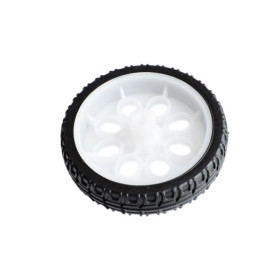
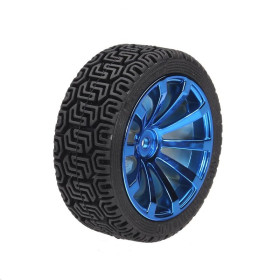
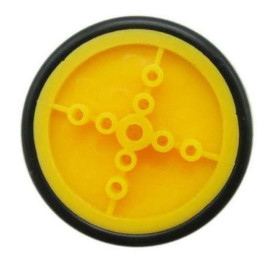
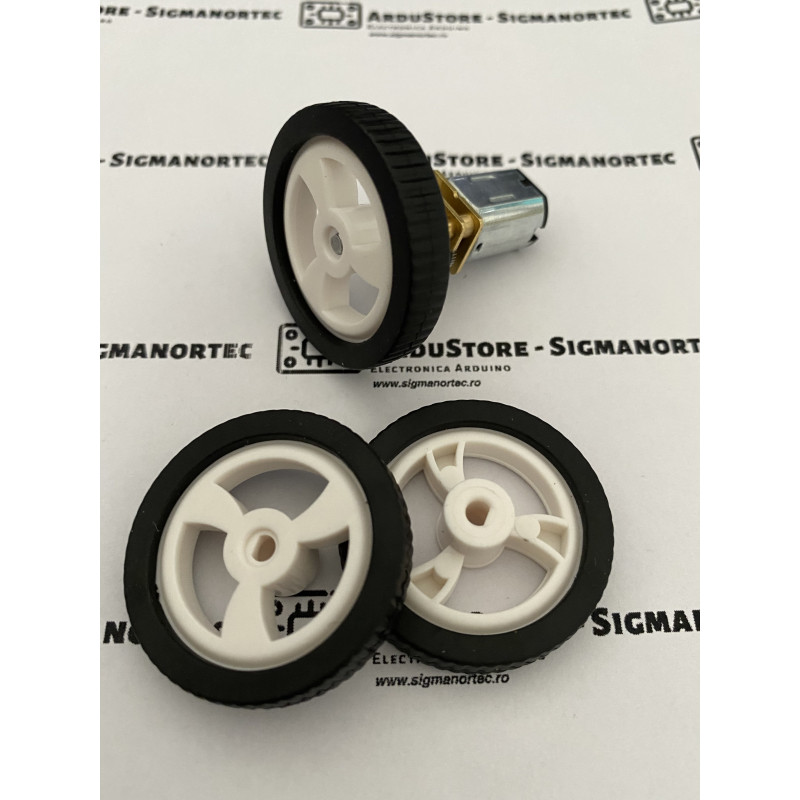
N20 Wheel, 35mm x 7mm, White Hub, Black Rubber, 3mm D-Hole
Compact rubber wheel for N20 motors, ideal for small robots and DIY projects where stable traction is needed. It has a diameter of 35 mm and a width of 7 mm, a profile with good grip on smooth surfaces, and a low weight of 3.2 g for efficiency and maneuverability, with quick mounting on the motor shaft.
Buying this product earns you 0.15 RON in loyalty points.

International fast shipping within EU. Free Shipping for orders above 100 EUR in most EU countries.

We ship from our stock within 24H

You earn points with every order, worth 5%.
The 35 mm rubber wheel is a mechanical accessory for N20 geared micromotors. It has a white plastic hub with three spokes and a black rubber tyre, which provides grip on smooth surfaces. It is suitable for small robots, educational cars, mobile platforms and prototypes where low weight matters.
The hub has a D-shaped hole that is press-fitted onto the 3 mm shaft with two flats used on N20 motors. The D shape prevents the shaft from slipping in the hub, so the motor rotation is transmitted directly to the wheel. The 35 mm diameter and 7 mm width give a circumference of approximately 110 mm, and the weight is only 3.2 g.
The main features include the white hub with three spokes, the 3 mm D-hole, the rubber tyre with a grooved tread profile and very low mass. The product has no electrical connections and does not require a power supply.
Specifications:
Type: Rubber wheel for N20 micromotors
Diameter: 35 mm
Width: 7 mm
Hub hole: D-shaped, for 3 mm shaft
Material: White plastic hub, black rubber tyre
Weight: 3.2 g
Dimensions: 35 x 7 mm
Usage:
Disconnect the motor from the power supply before mounting, so that the shaft does not start unexpectedly.
Check that the motor shaft has a D-shaped cross-section, with a diameter of 3 mm, and clean it of oil or dust with a dry cloth.
Align the flat side of the hub hole with the flat side of the shaft and push the wheel onto the shaft with even pressure, holding the motor by the housing and not by the shaft.
Do not force the wheel if the flats are not aligned. Turn it gently until it slides onto the shaft.
Stop when the wheel is seated on the shaft and leave a small gap between the hub and the gearbox housing, so that the wheel does not rub against the housing.
Turn the wheel by hand and check that it rotates without visible wobble and without rubbing against the housing or the motor bracket.
For a robot with two driving wheels, mount the wheel on the other motor in the same way and use motors with the same speed, otherwise the robot will deviate from a straight path.
For stable results, avoid dirty, dusty or wet surfaces, keep the wheels away from oil and lubricant and do not use solvents for cleaning. The wheels can be wiped with a damp cloth.
- Dimensions
- 35 x 7 mm
- Material
- White plastic hub, black rubber tire
- Type
- Rubber tire wheel for N20 micro motors
- Weight
- 3.2 g
- Width
- 7 mm
- Shaft diameter
- 3 mm
- Diameter
- 35 mm
Produs destinat utilizarii in proiecte electronice, automatizari, prototipare, educatie si cercetare.
Produsul trebuie utilizat numai conform specificatiilor tehnice mentionate in descriere si/sau in documentatia produsului.
Avertismente generale de siguranta:
Nu utilizati produsul la tensiuni, curenti sau temperaturi peste valorile specificate.
Montajul si conectarea trebuie realizate de persoane cu cunostinte tehnice minime in domeniul electric/electronic.
Evitati scurtcircuitele, inversarea polaritatii si conectarea gresita a alimentarii.
Nu lasati produsul alimentat nesupravegheat in timpul testelor.
Produsul nu este jucarie si nu este destinat copiilor.
Pentru modulele electronice, se recomanda utilizarea in carcase, panouri sau montaje protejate, dupa caz.
Identificare produs:
Denumirea produsului, codul/SKU-ul si caracteristicile tehnice sunt mentionate in pagina produsului si/sau pe eticheta ambalajului.
Producator / Importator / Distribuitor:
Sigmanortec S.R.L.
Calea Bucuresti nr. 9, Targu Jiu, Gorj, Romania
E-mail: [email protected]
Website: www.sigmanortec.ro
Persoana responsabila in UE:
Sigmanortec S.R.L.
Calea Bucuresti nr. 9, Targu Jiu, Gorj, Romania
E-mail: [email protected]
Documentatie si siguranta:
Pentru informatii suplimentare, fise tehnice, declaratii de conformitate sau instructiuni, ne puteti contacta la [email protected].
Reviews (5) - Review moderation

Foarte buna aderenaa
Imi pare bine ca le-am gasit, sunt usoare, subtiri, ieftine, bune pentru apicatii simple.
Bun
Solida, bine construita ,echilibrata. Foarte buna.
ttyyj
The 35 mm wheel with a width of 7 mm is a mechanical accessory for N20 type micro gear motors. It has a white plastic hub with three spokes and black rubber on the outside, and its low weight makes it suitable for small robots, educational cars, mobile platforms and prototypes.
As a mechanical part, the tutorial explains how to mount it on the motor, and how to check and estimate the speed of the robot, step by step.
How it works:
The hub of the wheel has a D-shaped hole, which fits onto the shaft with two flat sides of N20 motors. Thanks to the D shape, the shaft cannot slip in the hub, so the rotation of the motor is transmitted directly to the wheel. The rubber on the outside provides grip on smooth surfaces, such as a table, the floor or a workbench.
The distance travelled in one full rotation is the circumference of the wheel: C = 3.1416 x 35 mm, which is approximately 110 mm. The linear speed is calculated from the output shaft speed: v = C x n / 60, where n is the speed in revolutions per minute and v is in millimetres per second. In metres per second the formula becomes v = 0.00183 x n. To travel one metre, the wheel makes approximately 9.1 rotations.
| Shaft speed | Approximate speed |
|---|---|
| 50 RPM | 0.09 m/s |
| 100 RPM | 0.18 m/s |
| 200 RPM | 0.37 m/s |
| 300 RPM | 0.55 m/s |
The values in the table are theoretical, for a wheel that does not slip. In practice, the load, slipping and the supply voltage of the motor slightly reduce the actual speed.
Connection:
The product has no electrical connections and does not require a power supply. The only connection is the mechanical one between the hub of the wheel and the shaft of the N20 motor.
| Product pin | Connects to | Role |
|---|---|---|
| D hole of the hub | 3 mm D shaft of the N20 motor | Transmits the rotation of the motor to the wheel |
Configuration:
Disconnect the motor from the power supply before mounting, so that the shaft does not start unexpectedly.
Check the motor shaft. It must have a D-shaped cross section, with a diameter of 3 mm. Clean it of oil or dust with a dry cloth, because a clean surface holds better.
Align the flat part of the hole in the hub with the flat part of the shaft. If the two flat sides are not aligned, do not force the wheel, but rotate it gently until it slides onto the shaft.
Push the wheel onto the shaft with uniform pressure, holding the motor by its body and not by the shaft. Stop when the wheel is seated on the shaft, but leave a small gap between the hub and the gearbox housing, so that the wheel does not touch the housing when it turns.
Turn the wheel by hand and observe it. It must rotate without visible wobble and without rubbing against the housing or the motor bracket. If the wheel comes off the shaft during the test, remove it and repeat the mounting, making sure the shaft is clean.
Mount a second wheel on the other motor in the same way. For a robot with two driving wheels, use motors with the same speed, otherwise the robot will deviate from a straight path.
Usage example:
In a small robot with two N20 motors of 100 RPM, each with a 35 mm wheel, the theoretical speed on flat ground is approximately 0.18 m/s. The robot covers one metre in approximately 5.5 seconds.
Fix the two motors symmetrically, on the same axis, with the wheels at the same distance from the centre of the chassis. Add a support point with low friction at the back or the front, for example a ball or a free caster, so that the chassis sits horizontally.
Power the motors and check that the robot moves straight. If it deviates to one side, reduce the difference in speed between the motors or check that both wheels are pushed firmly onto the shaft.
Common problems:
The wheel slips on the shaft. The cause is usually a worn or dirty shaft, or the shaft not being fully inserted into the flat part of the hole. Clean the shaft, check the alignment of the flat side and, if necessary, use a small drop of thread locker on the shaft, avoiding the rubber.
The wheel comes off the shaft easily. The cause may be too much play between the shaft and the hub, or vibrations. Push the wheel more firmly onto the shaft, check that the motor is not overloaded and avoid side impacts.
The wheel rubs against the motor housing. The cause is mounting it too deep on the shaft. Pull the wheel slightly outwards until a small gap appears between the hub and the housing.
The robot deviates from a straight path. The causes may be different speeds of the motors, a wheel mounted with play, or an uneven surface. Check both wheels, use identical motors and compensate for the difference in the driver command.
The wheel wobbles when it rotates. The cause is mounting it at an angle on the shaft. Remove the wheel and mount it again, pushing it straight, without twisting it.
Limitations and tips:
The wheel is small and light, so it is suitable for low loads. For heavy robots or for climbing slopes, the grip and the strength of the plastic hub may become limited. Avoid dirty, dusty or wet surfaces, on which the rubber slips.
The wheel can be cleaned with a damp cloth. Do not use solvents, because they can damage the plastic or the rubber. Keep the wheels away from oil and lubricant, which reduce grip.
If you want to measure the distance travelled, use motors with an encoder and the circumference of 110 mm to calculate the distance from the number of rotations. For a more accurate measurement, measure the actual distance travelled in a test and adjust the circumference value in the program.